John Todd Stuart bowed to Lincoln in the White House Blue Room on December 19, 1863. “How are you, Stuart?” Lincoln asked, holding out his hand. Stuart had been Lincoln’s first law partner and was Mary’s cousin. He now sat in Congress as a Democrat, having beaten Lincoln’s friend Leonard Swett the year before. Stuart introduced Sue and Charley Craig, greeted Mary Lincoln, and went on to the East Room. He wrote to his wife that the Russian naval officers had come in full dress. His cousin Sue kept pointing out cashmere and cloth of gold among the women who accompanied them.
Earlier that month the Russian admiral had received members of the cabinet aboard his flagship, and Seward had given the officers dinner at his house. On the day the Lincolns received them at the White House, Seward read the president a dispatch from Cassius Marcellus Clay, the minister in Russia, denouncing Napoleon III. The French emperor had asked other governments to intervene first in the American war and then in Poland, where Alexander II had sent his younger brother to govern.

A commercial counterweight
In 1857, while Russia was recovering from the Crimean War, Grand Duke Konstantin wrote to Foreign Minister Alexander Gorchakov proposing that Russia sell its North American possessions to the United States. Konstantin was Alexander II’s younger brother and ran the navy. He wanted the empire to concentrate on reforms at home and on territory it could hold and develop more readily. Alexander marked the proposal as worth considering. The grand duke kept pressing it.

There were Americans willing to discuss a price. In the winter of 1859–60, Russian minister Eduard de Stoeckl sounded out John Appleton, an assistant secretary of state, and William McKendree Gwin, a senator from California. Gwin thought the United States might go as high as $5 million. Gorchakov considered the figure too low. By April 1861, Appleton was at the other end of the correspondence, serving out his last weeks as American minister in St. Petersburg. He brought Gorchakov a copy of Lincoln’s inaugural address and asked whether Russia would recognize the Confederacy.
Gorchakov told him that the emperor wanted the Union restored. He called the United States the world’s only commercial counterweight to Britain. Russia still meant to permit trade with Southern ports under the conditions then prevailing. Appleton objected to how the Russians proposed to handle ships and their papers. Gorchakov assured him that the rules would confer no recognition of Confederate nationality.
Gwin took a different course after secession. Federal authorities held him briefly at Fort Lafayette in 1861 and released him on parole. In June 1864 he arrived in Havana from Europe, carrying letters from Confederate envoys James Mason and John Slidell. He told Confederate diplomat William Preston that he had thrown in with Maximilian’s Mexican empire and was heading to Mexico to pursue the colonization of Sonora. Napoleon III backed his project. A year later, the Mexican republican envoy sent Seward intercepted Gwin letters and reported that the former senator was looking to bring disaffected Southerners to the Mexican frontier under French protection.
The War Department’s former chief
Lincoln’s first minister to Russia was Cassius Marcellus Clay, a Kentucky abolitionist. In 1862 Lincoln sent Simon Cameron to replace him. Cameron had lost the War Department amid a scandal over military purchasing. The House censured him for putting public money and purchasing authority in the hands of an agent without adequate oversight. Lincoln told Congress that the emergency decisions had been his and the cabinet’s as well. The day after Cameron presented his credentials to Alexander, he wrote to Lincoln from Russia to thank him for taking that responsibility in public.
Clay and Cameron went to the Winter Palace together on June 25. Clay handed over his letter of recall and Cameron took his place before the emperor. In his address, Cameron praised Alexander for emancipating the serfs and spoke of Americans engaged in their own struggle over the emancipation of labor. He described Russia advancing east and the United States advancing west until their telegraphs met. The two capitals could then speak, he said, “without the wires being touched by unfriendly hands.” Seward wrote back that Lincoln especially wanted Russia to remain assured of American friendship.

Wires at Peterhof
On July 16, 1862, Cameron took the train to Peterhof to discuss an American promoter’s plan to make that connection. Alexander’s eldest son, Nicholas, was on the same train. Cameron guessed that the young man had told Gorchakov of the party’s arrival, since an imperial carriage came for them and rooms were made available at the palace. Gorchakov heard Cameron out. He wanted a detailed proposal from Perry McDonough Collins before taking the matter further. After the meeting, the fountains were put into operation for the visitors and dinner was served at the palace.
Collins wanted to run a telegraph north through British Columbia and Russian America, cross the Bering Strait by cable and link up with the line Russia was extending across Siberia toward the Amur. The Atlantic cable laid in 1858 had failed after only weeks. Collins offered a second route to Europe while engineers were still trying to keep a wire working on the floor of the Atlantic.

On July 1, 1864, Lincoln approved an act giving the project a permanent right of way across unappropriated federal land. The Navy could lend a vessel to take soundings, carry equipment and help lay submerged cable. The War Department could order military posts to protect the line, and the United States reserved priority on the wires within its territory. Congress could authorize connections to military posts. Collins already had concessions from Russia and Britain. He now had an American law behind the project.
Western Union sent crews to both sides of the Pacific. By its own account, it erected 850 miles of line north from New Westminster and surveyed farther into Russian America and Siberia. In Alaska, the company worked with the Smithsonian and the Chicago Academy of Sciences. Robert Kennicott, the naturalist in charge of the Yukon division, was gathering specimens and geographical information as his party looked for a route. In 1866 he died at Nulato on the Yukon. His colleagues brought his remains downriver and sent them home to Chicago by way of Panama.
The fleet and the ballroom
Russia sent two squadrons to American ports in 1863 as Britain and France pressed Alexander over the Polish uprising. In July, the naval minister gave Rear Admiral Stepan Lesovsky instructions approved by the emperor. If war broke out, his ships were to strike at enemy commerce and attack weakly defended possessions. A squadron outside the Baltic could act before a British or French blockade shut it in. By late September, Russian warships were anchoring in New York Harbor.
Harper’s Weekly was already discussing a Russian alliance that October. In a letter published in the New York Sun on January 9, 1902, Philadelphia banker Wharton Barker said Alexander himself had explained the deployment to him at Pavlovsk on August 17, 1879. According to Barker, Alexander said he would have treated British and French recognition of the Confederacy as cause for war and sent the fleets to show he meant it. Barker had helped Russia acquire cruisers in Philadelphia in 1878, when his firm represented Baring Brothers. He told the story again in The Independent in 1904, during Russia’s war with Japan. Frank Golder published the naval instructions in 1915, and Thomas Bailey returned to the controversy in 1951.

On September 16, 1863, in New York Harbor, Mary Lincoln went aboard the Russian frigate Osliaba with General John A. Dix and toasted the emperor. Dix commanded the Department of the East. The following May, when a forged presidential proclamation reached the New York newspapers, Stanton would send the same general to take military possession of the Independent Telegraph Company’s offices, including the stations serving the Gold Room and the Brokers’ Exchange.
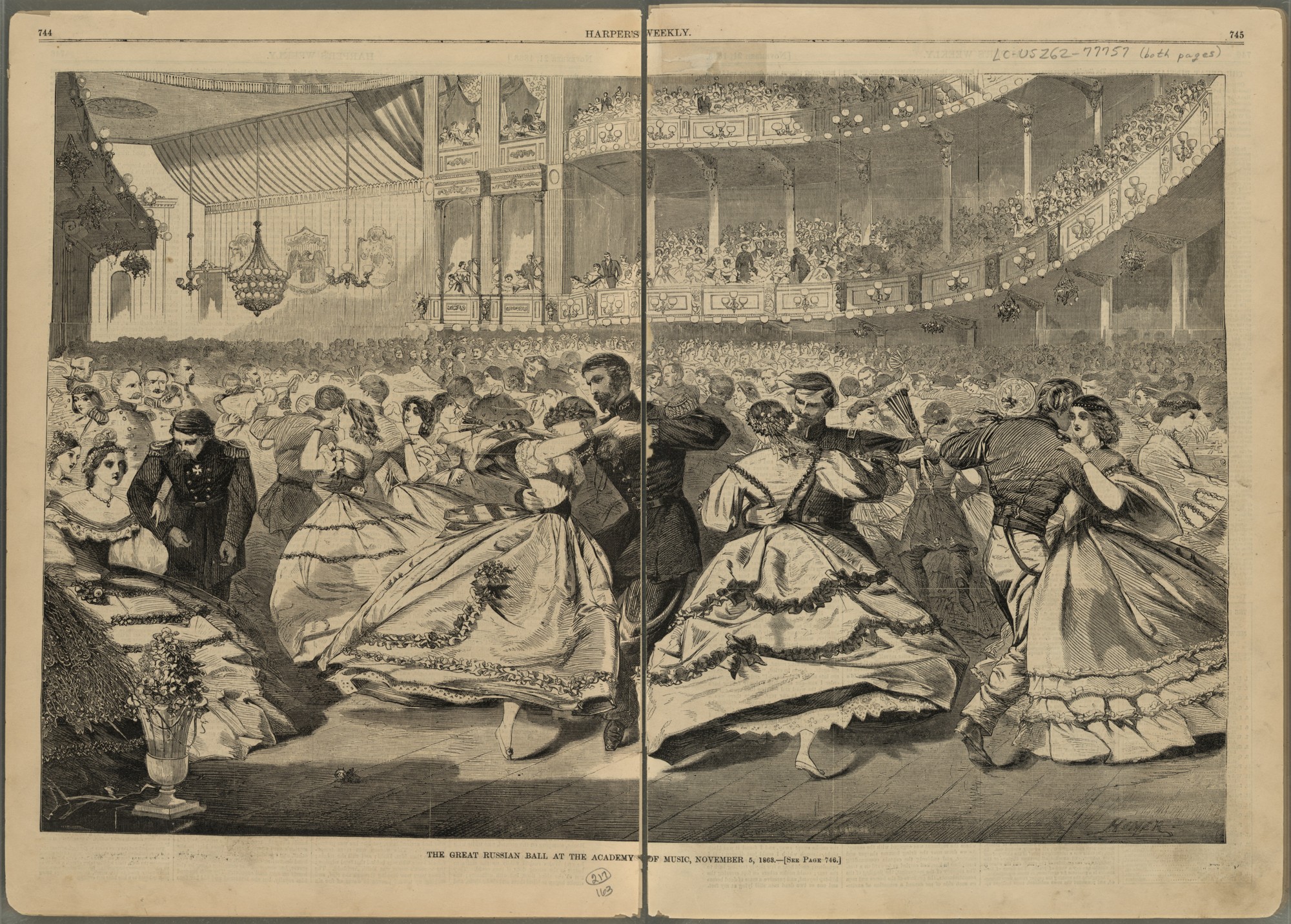
New York’s arrangements for the officers’ ball began at the Fifth Avenue Hotel. Mayor George Opdyke chaired the committee. Its organizers included John J. Cisco, the United States assistant treasurer in New York, along with members of the Astor and Brown families. Theodore Roosevelt Sr. served as secretary. The ball filled the Academy of Music on November 5. The following year the satirical pamphlet Abraham Africanus credited the affair to a chiropodist readers could recognize as Lincoln’s doctor, Isachar Zacharie.

Rear Admiral Andrei Popov favored San Francisco as a base from which to strike British or French possessions if war came. California merchants worried about Confederate raiders and the gold shipments going out through the Golden Gate. Popov was prepared to fire on a Confederate warship that tried to enter. Stoeckl cautioned him to preserve Russian neutrality. On October 23, fire swept the waterfront, and Popov sent officers and sailors ashore. Several were injured fighting the fire. The Board of Supervisors voted its thanks three days later.
In August 1864, with Lesovsky back in Russia, Alexander sent Samuil Alekseyevich Greig, whom Clay identified as Konstantin’s principal secretary, to thank the American legation. Clay arranged to return the visit. Greig took him and his secretary Henry Bergh out to the fleet beyond Kronstadt aboard the imperial yacht. An American flag flew at its masthead. Cannon greeted the yacht and then saluted again as it reached the flagship. At the meal aboard, the Russians drank first to Lincoln. Clay proposed a toast to “Alexander, the liberator.”
Nearly nine years earlier, Lincoln had used Russia to explain his feelings about the Know-Nothings. In an August 24, 1855 letter to Joshua Speed, he imagined what would happen if they prevailed and the country wrote its exclusions of Black people, immigrants and Catholics into its definition of liberty. He said he would rather emigrate “to Russia, for instance, where despotism can be taken pure, and without the base alloy of hypocrisy.”

Related families, competing governments
At the White House in August 1861, Lincoln had given a dinner for Prince Napoléon, the son of Jérôme Bonaparte and first cousin of Napoleon III. The prince’s sister Mathilde had married Anatole Demidov, heir to a Russian mining fortune. Another first cousin of the French emperor, Maximilian of Leuchtenberg, married Alexander II’s sister Maria in 1839. Maximilian died in 1852. His children grew up inside the Russian imperial family while Napoleon III ruled France.
On January 24, 1862, after Washington released the Confederate envoys James Mason and John Slidell and their secretaries, all seized from the British mail steamer Trent, Gorchakov read Clay the letter he had sent to Stoeckl congratulating Lincoln’s government on the settlement. He warned that conquest would leave the Union with “a sore and discontented population” and urged reconciliation. Clay said the Union would deal generously if the South listened, and would “war it out to the bitter end” if it refused.
In November 1862, Napoleon III asked Britain and Russia to join France in proposing a six-month armistice to the Union and the Confederacy. Gorchakov read his instructions to Stoeckl aloud to Bayard Taylor, who was running the American legation after Cameron’s departure. Russia withheld its support from the joint proposal and left open the possibility of helping on terms acceptable to Washington. Taylor told Seward that even governments friendly to the Union were growing impatient. In Taylor’s reading, Russia feared that a long war would leave North and South, reunited or divided, too weak to resist other powers.
When the Polish uprising began in January 1863, Konstantin was Alexander’s viceroy in Warsaw. France asked the United States to join it, Britain and Austria in making representations to the tsar. On May 11, Seward turned down the invitation and invoked the American practice of staying out of other countries’ internal conflicts. He sent Clay a copy of his answer and authorized him to make its contents known to Gorchakov informally. At the American legation the following year, Bergh used the phrase “mysterious alliance” for the friendship and traced it to the two governments’ practice of leaving each other’s domestic affairs alone.
Early in the war, Seward’s department hired Count Adam Gurowski, a Polish exile who spoke eight languages, to translate foreign newspapers. In Europe he had gone from the Polish revolutionary movement to service in the Russian government and had placed his hopes for the Slavs in reform under the tsar. His published diary was scathing about the Lincoln administration. In April 1863 he recalled British speeches in support of the Poles in 1831, followed by Russian victory. He hoped Russia and the United States would someday join hands. Writing from New York in September, he praised Gorchakov’s answer to the European powers over Poland and asked why Seward could never write with such precision.
A Sufi intermediary and a Russian captive
By 1864, Abdelkader was living in Damascus. Napoleon III had released him from French captivity in 1852. In early 1865 the Algerian emir wrote to Imam Shamil, a Naqshbandi Sufi leader who had fought Russia in the Caucasus and was being held at Kaluga. Abdelkader offered to ask Alexander to let Shamil leave for Mecca or Medina. That fall he took the request to the Russian embassy in Constantinople and suggested Shamil stop in Damascus on the way home. The government finally allowed Shamil to make the pilgrimage in 1869.
In 1864, a man with firsthand experience of the Russian aristocracy was serving in the 55th Massachusetts Infantry. He was born Mohammed Ali ben Said to a Muslim family in Bornu and was enslaved as a boy. In his account of his travels, he recalled entering the service of Prince Alexander Menshikov, whose embassy to Constantinople preceded the Crimean War. He later served Prince Nicholas Troubetzkoy and took the name Nicholas when he was baptized in the Russian Orthodox Church. In 1863, years after leaving Russia, Nicholas Said enlisted in the Union Army. He rose to sergeant.

One of the Russian sailors who reached New York was Yusup Khalimov of Lesovsky’s flagship, the Alexander Nevsky. He died on April 8, 1864. Green-Wood Cemetery indexes his burial under “Isauh Haliwos,” though the handwriting in the ledger looks closer to “Isup Halimov.” The entry gives his birthplace as Russia, his age as thirty-four and his cause of death as consumption. His given name, a form of Yusuf, suggests a Muslim background. His last address was New York’s City Hospital. He was buried in Brooklyn the next day, in lot 8999, grave 156.

The payment after the presidency
Clay learned of Lincoln’s assassination from a telegram relayed by the American minister in London. On April 27, 1865, he formally notified Gorchakov. The prince answered the next day. His letter was dated April 16 on the Russian calendar, April 28 on the calendar used in Washington. Gorchakov conveyed the sympathy of the imperial cabinet in the emperor’s absence. Alexander had gone to Nice to be with his eldest son Nicholas, the young man who had ridden to Peterhof on Cameron’s train. Nicholas died there on April 24.
In his May 4 dispatch, Clay listed the callers. Konstantin sent his aide Greig. Grand Duchess Helen, who had backed the commission that prepared serf emancipation, sent Baron Rosen and invited Clay to call on her informally. The Prince of Oldenburg came to the legation himself. Clay enclosed Gorchakov’s reply and letters of condolence from the diplomatic corps. He told Seward how thankful he was that the secretary had survived the attack on him.
In late June, in the waters Collins planned to cross, the Confederate raider Shenandoah captured about two dozen American whalers. On June 28 it fired one of the last shots of the Civil War across a whaler’s bow. By August 3, after speaking with a British vessel out of San Francisco, its captain James Waddell had definite word that the war was over. The raider had begun as the British Sea King. James Dunwoody Bulloch arranged its purchase through the Confederate naval operation in Liverpool in October 1864. It was armed and commissioned off Madeira. Bulloch was the half brother of Martha Bulloch Roosevelt, whose husband had served as secretary of New York’s Russian Ball committee.
In 1866 Alexander survived an attempt on his own life. Congress passed a resolution of congratulation and sent Gustavus Fox, who had served as Lincoln’s assistant secretary of the navy, to deliver it. The mission brought the American monitor Miantonomoh to Kronstadt in August. Fox presented the resolution to Alexander, and Lesovsky accompanied him on the trip to Moscow.
In December 1866, Finance Minister Mikhail Reutern wrote to Gorchakov about the cost of keeping Russian America. Now that Americans had permission to run a telegraph through the colony, he expected clashes with the Russian-American Company over its exclusive trading rights. Russia could end up paying to keep soldiers and ships in the North Pacific to defend an unprofitable company against Americans, at the expense of relations with Washington. A sale, he argued, would put the United States on the northwestern as well as the southern side of Britain’s colonies. That month Alexander met with Reutern, Konstantin, Gorchakov, Stoeckl and the naval minister. They agreed to sell. Stoeckl went back to Washington to settle the terms with Seward.
The Atlantic cable had gone into lasting service in 1866. On March 25, 1867, Western Union told Seward it was suspending work on the overland line. Five days later, Seward and Stoeckl signed the Alaska treaty. When Charles Sumner made the case for ratification, he cited what the telegraph expedition had learned about the territory, including how the Yukon’s waters reached the Bering Sea. The expedition had gone looking for a route to Russia. Its findings were now helping the Senate judge the country it was about to acquire.
The Treasury issued a $7.2 million warrant to Stoeckl in August 1868. He endorsed it to George W. Riggs, who had once been William W. Corcoran’s banking partner. Corcoran’s son-in-law George Eustis Jr. was Slidell’s secretary, one of the four men taken off the Trent. Another man in the transaction had spent the war trying to strengthen Union credit in London. Robert J. Walker, a former Treasury secretary who had worked there for Salmon P. Chase, was now Stoeckl’s counsel, hired to help get the Alaska appropriation through Congress.

Riggs’s account to a House committee put $165,000 of the warrant outside the Baring remittance. He paid Walker $26,000 in gold on Stoeckl’s order and recalled making four payments totaling $139,000 to Stoeckl himself. Riggs’s knowledge of that balance ended with his payments to the envoy.
Walker testified that he paid his associate F. P. Stanton $5,000 in greenbacks out of his fee. He also said that with Stoeckl’s consent he paid D. C. Forney of the Washington Daily Chronicle the equivalent of $3,000 in gold for the paper’s support of the purchase. That payment came several weeks after Congress approved the appropriation. Walker said the paper had been promised nothing in advance.
Russia’s finance ministry later recorded that nearly eleven million rubles from the sale went to purchases of railway equipment abroad. Riggs sent $7,035,000, less his commission, to the New York agent of Baring Brothers of London, the house Barker Brothers represented a decade later when Russia bought cruisers in Philadelphia.