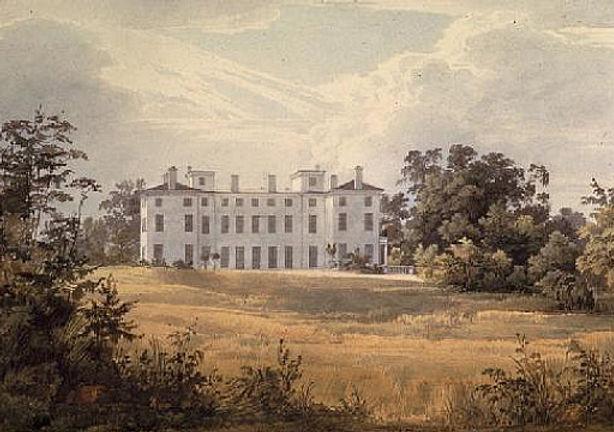


There were really two American Bonaparte centers in the nineteenth century, and looking at them together changes the story. The obvious one was Point Breeze, Joseph Bonaparte’s extraordinary estate outside Bordentown, New Jersey, where the former king of Naples and Spain reconstructed the material world of a European court after Napoleon’s empire collapsed. The less obvious one was Baltimore, where Napoleon’s younger brother Jérôme married Elizabeth Patterson in 1803 and unintentionally created an American Bonaparte dynasty that remained rooted in Maryland long after the European marriage had been repudiated.
Seen separately, these look like colorful episodes in early American history. Seen together, Baltimore and New Jersey look like two different solutions to the same problem: how does a royal house survive when it no longer possesses a kingdom? New Jersey held the exiled king, his estate, collections, visitors and international memory. Baltimore held the contested marriage, the American descendants, the money, the name and eventually a Bonaparte who entered the highest machinery of the United States government.
That distinction becomes even more intriguing because Joseph Bonaparte was not merely a deposed monarch. During the Napoleonic period in which the American branch of the family was being created, Joseph became Grand Master of the Grand Orient of France, one of the central Masonic organizations of Europe. Later, a Baltimore-born Bonaparte would become Attorney General of the United States just as the federal government was attacking another peculiar form of concentrated authority centered legally in New Jersey: Rockefeller’s Standard Oil combination.
That does not prove that a Bonaparte organization secretly became a Rockefeller organization. It does reveal a much more interesting historical progression: royal court, family network, fraternal administration, corporate holding company and federal investigative bureaucracy all appear along the same Atlantic corridor within roughly a century.
Baltimore Was Already a Bonaparte City Before Joseph Reached New Jersey


Baltimore’s Bonaparte story begins on Christmas Eve 1803, when Jérôme Bonaparte married Elizabeth Patterson, the daughter of a wealthy Baltimore merchant family. Napoleon rejected the marriage, Jérôme eventually returned to Europe, and the French imperial government refused to recognize Elizabeth as his legitimate dynastic wife. Elizabeth nevertheless retained the Bonaparte name, raised their son, pursued recognition of his rights and spent much of the rest of her life moving between American wealth and European aristocratic ambition.
That alone made Baltimore more than the accidental site of a celebrity marriage. Elizabeth became a long-lived American representative of the Bonaparte claim, and Maryland historical scholarship emphasizes how deliberately she preserved that identity. She fought over legitimacy, cultivated the family’s material memory and turned her own investments into substantial wealth; the Maryland Historical Society has described her fortune near the end of her life as exceeding one million nineteenth-century dollars.
Her son, Jerome Napoleon Bonaparte, remained part of Baltimore society, and the family produced another generation there. Charles Joseph Bonaparte, born in Baltimore in 1851, was Elizabeth’s grandson and Jérôme Bonaparte’s grandson. Maryland records place his legal practice, reform work and much of his civic life firmly in Baltimore before his rise into Theodore Roosevelt’s cabinet.
That is why calling Baltimore a second Bonaparte court can be useful, provided “court” is understood functionally rather than literally. There was no throne room and no sovereign territory. What Baltimore preserved was the dynastic household: surname, inheritance, portraits, documents, marriage claims, social standing, Catholic connections, wealth and successive generations who continued to understand themselves as Bonapartes.
Point Breeze possessed the king.
Baltimore possessed the lineage.
Joseph Bonaparte and the Masonic Government of the Empire
Joseph’s Masonic role makes this picture considerably stranger, although it needs to be stated precisely. He was not “head of all Freemasonry,” and it would be misleading to describe him that way. He was appointed Grand Master of the Grand Orient of France in 1804, shortly after Napoleon became emperor, while Joseph’s brother Louis held another senior Masonic position and Jean-Jacques-Régis de Cambacérès handled much of the actual administration. Fondation Napoléon’s historical account dates Joseph’s appointment to November 1804 and describes the December union that placed the Grand Orient into a close relationship with the imperial state.
That appointment occurred almost exactly as the Baltimore Bonaparte crisis was unfolding. Jérôme had married Elizabeth in December 1803; Joseph became Grand Master the following year; and Napoleon was simultaneously reorganizing Europe around members of his own family. Masonic administration during the Empire became populated by Bonapartes, marshals, senators and senior officials rather than existing as some unrelated underground society. Contemporary histories of the period describe Joseph’s Grand Mastership as part of an overt imperial strategy for managing a large and influential fraternal system.
There is an important chronological limit here. Joseph’s effective Grand Mastership belongs to the Napoleonic phase, ending with the collapse of the Empire in 1815; he was not sitting at Point Breeze in the 1820s secretly administering French Masonry from New Jersey. Some histories note that the office technically remained unresolved for years, but the active imperial system had ended. That makes the sequence more interesting, not less: Joseph arrived in America carrying the experience of someone who had already been king, diplomat and titular head of a vast fraternal organization.
When he began constructing Point Breeze, therefore, he was not learning for the first time how a dispersed hierarchy worked.
Point Breeze Was the Landed Court
Joseph purchased the core of Point Breeze in 1816 and eventually enlarged the estate to roughly 1,800 acres. The property rose above the Delaware River near Bordentown and became one of the most elaborate picturesque landscapes in the early United States, complete with a grand residence, extensive grounds, art, books and a steady stream of prominent visitors.

This was the physical court that Baltimore lacked. Joseph could no longer govern Spain or Naples, but at Point Breeze he could still assemble the things that make a court socially powerful: a household, a collection, hospitality, correspondence, servants, family memory and access to important people. The palace and kingdom had separated.
That is the essential difference between Baltimore and Bordentown. Point Breeze concentrated Bonaparte authority spatially; Baltimore preserved it genealogically. One was an estate. The other was a family system.
The two were not unrelated worlds. Elizabeth Patterson Bonaparte spent decades trying to secure a legitimate place for her son in the wider Bonaparte dynasty, while Joseph remained one of the senior surviving figures of that dynasty in America. Maryland sources preserve a tradition that Elizabeth’s son was at one point encouraged to marry one of Joseph’s daughters, which would have joined the disputed Baltimore line directly back into Joseph’s recognized family. He did not do so.
The marriage never happened, but the geography remained remarkable. An exiled Bonaparte king sat on the Delaware corridor in New Jersey while an American Bonaparte branch matured in Baltimore.
The Baltimore Court Eventually Entered Washington


The most extraordinary transformation occurs two generations later with Charles Joseph Bonaparte. He did not spend his career trying to recover a European title. He became a Baltimore lawyer, civil-service reformer and ally of Theodore Roosevelt, eventually serving as Secretary of the Navy from 1905 to 1906 and Attorney General from 1906 to 1909.
Under Bonaparte, the Department of Justice created its own permanent investigative force. On July 26, 1908, he ordered that Department of Justice investigative matters be referred to a new group of special agents, the organization from which the Bureau of Investigation and eventually the FBI developed. The FBI itself treats Bonaparte’s 1908 directive as its institutional birth.
There is a remarkable historical symmetry here. Joseph Bonaparte had occupied a system in which dynasty, state administration and fraternity overlapped. A century later his Baltimore descendant occupied an American cabinet office and helped create a centralized federal investigative service.
The forms could hardly look more different.
The function—organizing information, authority and agents beneath a central office—is at least comparable.
That comparison is interpretation, not proof of institutional descent. But it is exactly the kind of transformation that makes the Baltimore–Point Breeze story worth following beyond genealogy.
Then New Jersey Became the Corporate Court


By the end of the nineteenth century, New Jersey had acquired another peculiar place in American power. Its increasingly permissive corporation laws made it attractive to large combinations seeking a legal structure through which one corporation could own stock in others. Rutgers’ history of Standard Oil notes that New Jersey’s late-1880s corporate legislation helped make the state a preferred jurisdiction for trust incorporations.
This is where Rockefeller enters the same geography.
Standard Oil had begun in Ohio, and its famous business headquarters eventually occupied 26 Broadway in New York. New Jersey was therefore not the Rockefeller organization’s everyday physical capital in the same sense Point Breeze had been Joseph’s home. Its importance was more abstract and arguably more modern: New Jersey became the legal body through which the combination could be centralized.
The Supreme Court’s own account of the Standard Oil case makes that transformation unusually explicit. In 1899 the Standard Oil Company of New Jersey’s charter was expanded so that it could acquire and vote stock in other corporations, hold property broadly, operate pipelines and transportation systems, control patents and conduct business far beyond New Jersey. Stock of numerous companies was then transferred into the New Jersey corporation, turning it into the principal holding vehicle for the wider Standard system.
That is an extraordinary institutional development when placed beside Point Breeze.
Joseph’s court centralized people and property because the king and the estate physically held them together.
The Rockefeller-era corporation centralized power because a legal person held shares in other legal persons.
The estate had become a charter.
The Bonaparte Who Prosecuted Rockefeller’s New Jersey System
Here the two stories actually cross in documented history.
Charles Joseph Bonaparte became Attorney General in December 1906. The federal Standard Oil antitrust case had been filed shortly before his appointment, in November 1906, and the litigation continued during his tenure; Maryland biographical records specifically list the Standard Oil prosecution among the major matters handled during his administration of the Justice Department.
Think about the historical reversal.
A Baltimore grandson of Jérôme Bonaparte and Elizabeth Patterson—descended from the American branch created when Napoleon refused to recognize their marriage—was now the chief legal officer of the United States while the government attacked a giant holding system organized through Standard Oil Company of New Jersey.
The federal case eventually reached the Supreme Court, which in 1911 ordered the combination dismantled. The Court described the New Jersey company as the holding corporation through which control over the many subsidiaries had been concentrated and prohibited it from continuing to exercise that control through stock ownership.
Yet dissolution did not make the New Jersey shell irrelevant. Jersey Standard survived as one of the major independent companies produced by the breakup and ultimately became a principal ancestor of ExxonMobil. ExxonMobil’s own corporate history traces that lineage directly through Standard Oil Company of New Jersey.
New Jersey had therefore hosted two very different kinds of “court” within a century.
One belonged to a dispossessed European king.
The other belonged to the corporation.
Where the “Rockefeller Commission” Idea Actually Fits
This is also where I think the Rockefeller Commission language from the larger research becomes useful, as long as it is labeled for what it is. There is no documentary evidence here of an organization officially called the “Rockefeller Commission” secretly inheriting Joseph Bonaparte’s American court. The internal research treatment instead uses “commission” as a model for distributed functions—capital, custody, transport, signal, material infrastructure, regulation and archives—being carried by different families and institutions rather than by one continuously documented secret board.
Under that definition, New Jersey really does become a compelling location for the Rockefeller side of the model. The state supplied a legal jurisdiction in which a company could become the owner and coordinator of many outwardly separate companies. The Supreme Court itself described the New Jersey entity as the holding corporation through which control was centralized.
That is substantially different from claiming that Rockefeller inherited Joseph Bonaparte’s throne.
It is more interesting to say that New Jersey preserved the location while the technology of concentration changed.
At Point Breeze, power had been organized around a person, household and estate.
At Standard Oil of New Jersey, power could be organized around stock ownership, charters, boards, subsidiaries, transportation systems and patents.
The larger Royalty Trust research has been circling exactly this transformation: royal title gives way to court and property; property becomes corridor and institutional custody; industrial power becomes patent and trust; and later forms of ownership migrate into media, intellectual property and family brands.
Baltimore and New Jersey Were Doing Different Jobs
This also explains why Baltimore should not be treated merely as a footnote to Point Breeze.
Baltimore carried the Bonaparte name forward inside America. Elizabeth preserved the dynastic argument. Her descendants inherited the name and family memory. Charles Joseph Bonaparte converted that inheritance into something entirely American: law, reform politics, executive office and eventually the institutional ancestry of the FBI.
New Jersey performed another function. It first gave Joseph a physical location where a fallen European royal household could be reassembled. Decades later, the state’s corporate law made it possible for large concentrations of industrial property to be organized through a single holding company whose authority did not depend on a palace, noble title or blood succession.
The two centers therefore almost mirror each other.
Baltimore preserves the house. New Jersey preserves the mechanism.
In 1803, the American Bonaparte question was about whether a Baltimore woman and her child could be recognized as members of a European dynasty.
By 1908, her grandson was running the United States Department of Justice and creating a permanent federal investigative force.
At almost the same moment, the government was trying to break the corporate concentration centered legally in Standard Oil of New Jersey.
That is a much larger story than the odd fact that Napoleon’s relatives once lived in America.
The Court Without a Crown
Perhaps the most revealing thing about the American Bonapartes is that none of these systems required the crown to survive.
Joseph lost Naples and Spain but retained enough wealth, status and relationships to build Point Breeze.
Elizabeth lost recognition by Napoleon’s imperial family but established a durable Baltimore Bonaparte line anyway.
Joseph’s formal Masonic authority disappeared with the Empire, yet the kind of administrative world it represented—hierarchy, correspondence, recognized offices and dispersed chapters—did not disappear from modern institutional life. Joseph’s Grand Mastership belongs specifically to the Grand Orient of France and should not be turned into evidence for an imaginary universal Masonic command, but it matters because it shows how thoroughly dynastic and organizational authority could overlap in the Bonaparte period.
Then the language changed.
The royal house became the prominent family.
The court became the board.
The estate became the corporation.
The charter replaced the title.
The agent replaced the household retainer.
The trust could control territory without owning a kingdom.
And New Jersey—where Joseph Bonaparte once tried to reconstruct the physical life of a fallen European court—became one of the places where corporate America learned how to concentrate enormous power without needing a palace at all.