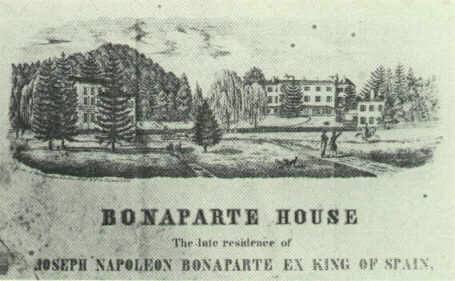


There is a strange piece of European history buried in New Jersey. Less than forty miles from Philadelphia, on high ground above the Delaware River at Bordentown, the older brother of Napoleon Bonaparte spent more than twenty years rebuilding something that officially no longer existed. Joseph Bonaparte had been King of Naples and then King of Spain. After Napoleon’s empire collapsed, he crossed the Atlantic, settled in the United States, and created an enormous estate called Point Breeze. From 1816 until 1839, the former king lived there on and off amid paintings, sculpture, books, servants, gardens, tunnels, artificial lakes and some of the most elaborate landscaped grounds in the young republic.
Calling Point Breeze a rich man’s country house does not quite capture what Joseph created. He had lost his throne, but he had not ceased to be a Bonaparte. He arrived with wealth, objects, correspondence, social connections and the habits of a European court. American politicians, military men, intellectuals and foreign visitors passed through his New Jersey household. Point Breeze therefore presents an unusual historical problem: what exactly becomes of royalty when the kingdom is gone but the king, his property and his network remain?
That question becomes even stranger because Point Breeze itself eventually vanished.
A King Without a Kingdom
Joseph Bonaparte was not merely Napoleon’s relative living comfortably in exile. Napoleon had installed him as King of Naples in 1806 and King of Spain in 1808. When the Napoleonic order finally collapsed after Waterloo, Joseph fled Europe and reached the United States in 1815. New Jersey records describe him living in the state from 1816 until 1839, where he developed Point Breeze into an estate of roughly 1,800 acres.
The contrast with the surrounding republic was extraordinary. Joseph brought an enormous European collection with him. A Monmouth University account of archaeological and historical work at Point Breeze describes a library of about 8,000 books, more than two hundred paintings, sculpture, porcelain and other luxury objects. To put that library in context, the Library of Congress had acquired Thomas Jefferson’s 6,487-volume collection only after the British destruction of Washington in 1814.
Point Breeze was therefore something much more interesting than an eccentric exile’s mansion. A former European monarch had transferred a significant portion of his material court across the Atlantic and reassembled it inside the United States.
He could no longer issue decrees from Madrid. He could, however, maintain a household, collect art, entertain important visitors, preserve family papers, manage property, employ large numbers of people and remain connected to European dynastic affairs. The crown had disappeared from his head, but many of the practical things surrounding a crown had survived the voyage.
The Palace on the Delaware
The setting mattered. Point Breeze stood on the Delaware River near Bordentown, between Philadelphia and New York. Joseph transformed the property into one of the most remarkable designed landscapes in early nineteenth-century America. New Jersey’s Historic Preservation Office describes two palatial residences built there during his time, surrounded by a deliberately picturesque landscape. Other accounts describe miles of carriage paths, ornamental bridges, a man-made lake, gardens and underground passages connecting portions of the estate.
Those tunnels are not simply a later legend. The National Gallery of Art’s history of early American landscape design describes subterranean passages modeled partly on Joseph’s European estate at Mortefontaine. One route connected the manor toward the lake, with access to areas including the wine cellar, lake house and icehouses. Their mundane purpose appears to have been service and supply: goods and workers could move through portions of the estate without disrupting the carefully composed landscape above.
That detail is almost too perfect. Point Breeze was designed so that the visible world and the operating world could be separated. Guests experienced landscape, architecture, art and hospitality. Beneath and behind that appearance existed storage, movement, labor and logistics.
That does not make Point Breeze a secret headquarters. It makes it a court.
A court has always been both spectacle and machinery.
America Had a Bonaparte Problem
Joseph’s presence also exposed an uncomfortable contradiction in the young United States. This was a republic created in opposition to hereditary monarchy, yet one of Europe’s most famous royal families had established a miniature world inside it.
He was hardly invisible. Joseph used the title Count de Survilliers, but his identity was widely known. His estate became a destination, and his art collection attracted serious attention. Monmouth University’s account notes that even the New Jersey legislature visited Point Breeze to see the collection.
Nor was Bordentown an isolated retreat at the edge of civilization. It sat directly on an increasingly important transportation corridor. A contemporary travel account preserved by the Library of Congress described Joseph’s estate close to the developing rail line, while later federal transportation histories document the Camden and Amboy Railroad running through the Bordentown system beginning in the 1830s. By 1840, connected lines were helping establish all-rail movement between the Philadelphia and New York regions.
That geography changes how Point Breeze looks.
A royal exile had not merely hidden himself on an inaccessible country estate. He had positioned his American household beside one of the country’s great emerging corridors of movement.
Then the Court Was Taken Apart
Joseph returned permanently to Europe in 1839 and died in Florence in 1844. Point Breeze passed to his grandson, Joseph Lucien Bonaparte, and the estate entered a remarkably rapid process of dispersal. The National Gallery’s landscape-history project records the sale of Joseph’s possessions and estate several years after his death, followed by subsequent transfers of the property.
One surviving document makes the transformation almost painfully literal.
The Library of Congress holds an 1847 map of the residence and park grounds of the late Joseph Napoleon Bonaparte, ex-King of Spain. The map was not created merely to celebrate the estate. Its own notation states that the property was to be sold at auction on June 25, 1847. The royal landscape had become a sale catalogue.
The palace became parcels.
The collection became objects.
The household became transactions.
The former King’s New Jersey world was being converted into ordinary American property.
This is where the Point Breeze story becomes far more interesting than an anecdote about Napoleon’s brother.
What Happens to a Court When You Sell the Palace?
The research framework behind the broader Royalty Trust project starts with exactly this problem. It proposes looking at Point Breeze not as evidence of a hidden monarchy but as an unusually clear historical example of how concentrated court functions can be broken apart and redistributed. The working treatment describes a progression in which dynastic authority is decomposed into property corridors, recognition networks, security systems, industrial trusts, media rights and ultimately inheritable brands.
Point Breeze offers a surprisingly good physical model for that idea because we can actually watch the process happen.
At the beginning stands a former king occupying a coherent estate. One place contains residence, collection, household, landscape, memory, hospitality, correspondence and status.
Then the center disappears.
But everything does not disappear with it.
The artwork goes somewhere. The books go somewhere. The papers go somewhere. The land acquires new owners. The transport corridor continues operating. Family members retain the Bonaparte name. Relationships survive the house in which they were once conducted. Property once concentrated in one royal environment is converted into a dispersed set of assets.
This is what makes the phrase portable sovereignty useful. It does not require believing that Joseph secretly ruled anything from New Jersey. It describes the simpler phenomenon visible in the record: losing a throne did not erase every social, financial, familial and institutional capability that had once surrounded that throne.
The palace was only one container.
The Railroad Outlived the King
There is another layer that makes the chronology particularly suggestive. During Joseph’s American years, the transportation technology surrounding Point Breeze was changing rapidly. Steamboats and roads were joined by railroads. Bordentown became an important junction in the developing Camden and Amboy system, tying the Delaware corridor more tightly to Philadelphia, South Amboy and the greater New York route.
The old European court had been spatial. A ruler, household, archive, treasury, servants, visitors and art accumulated around a palace.
The emerging American system was increasingly networked.
The important object was no longer necessarily the palace. It could be the route connecting cities, the corporation controlling a line, the bank financing it, the telegraph accompanying it, the lawyers controlling title or the institutions determining whose papers would be recognized at the other end.
The broader research corpus repeatedly returns to this transformation. Its central proposition is that nineteenth-century sovereignty did not simply vanish as corporations, railroads, banks, police networks and industrial trusts expanded. Some of its practical functions became portable and institutional. In that model, the court becomes a network, the warrant becomes a charter, the treasury becomes a bank, the messenger becomes a communications system and the palace becomes a central station.
Point Breeze does not prove that argument by itself.
It gives us a place where we can watch the metaphor becoming physical.
The Palace Really Did Disappear
By 1850, Henry Beckett had acquired the central property. Historical sources differ in how they describe Beckett’s diplomatic connection—some older accounts identify him directly with British consular activity while modern historical work describes him as the son of a British consul—but they agree on the more important physical event: the Bonaparte mansion was demolished.
Today the great house is gone.
The state of New Jersey has helped preserve a surviving section of Point Breeze as parkland, and archaeology has recovered substantial evidence from the site. New Jersey’s preservation program notes archaeological remains from both the Bonaparte estate and much earlier Native American occupation. The surviving landscape has become the Delaware and Raritan Canal State Park at Point Breeze, preserving part of a place that had once contained a former king’s reconstructed world.
That gives the story a strange ending.
Joseph Bonaparte lost Spain.
Then he lost Europe.
He built another court in New Jersey.
That court was eventually auctioned, divided and demolished.
Yet the Bonaparte name survived. The transportation corridor survived. The documents survived. The art survived in dispersed collections. The property continued changing hands. Archaeology eventually recovered the material residue beneath the ground. Two centuries later, the vanished estate is again being reconstructed—not as a monarchy, but as history.
The building failed to survive.
The network of things that made the building meaningful did.
The Real Mystery of Point Breeze
The tempting question is whether something secret was happening at Point Breeze. There are tunnels, a deposed king, enormous wealth, European correspondence and a location directly between major American cities. That combination almost begs for conspiracy.
But the more interesting question does not require one.
Point Breeze demonstrates how much of a court can continue to exist after political sovereignty has formally ended. Joseph possessed no American throne, yet he still possessed household, wealth, collection, family, reputation, access, correspondence and property. He could no longer command a kingdom, but he could still create a place where powerful people came to him.
Then even that place disappeared.
What remained was distributed.
That may be the real significance of the vanished palace at Bordentown. The nineteenth century was beginning a gigantic transformation in which power increasingly belonged to systems capable of surviving the disappearance of any single building or individual. Railroads did this. Banks did it. Corporations did it. Trusts did it. Telegraph networks did it. Newspapers did it. Eventually film studios, broadcast networks and intellectual-property companies would do it as well.
A palace concentrates power by putting everything in one place.
A modern network does something more durable.
It makes the palace unnecessary.