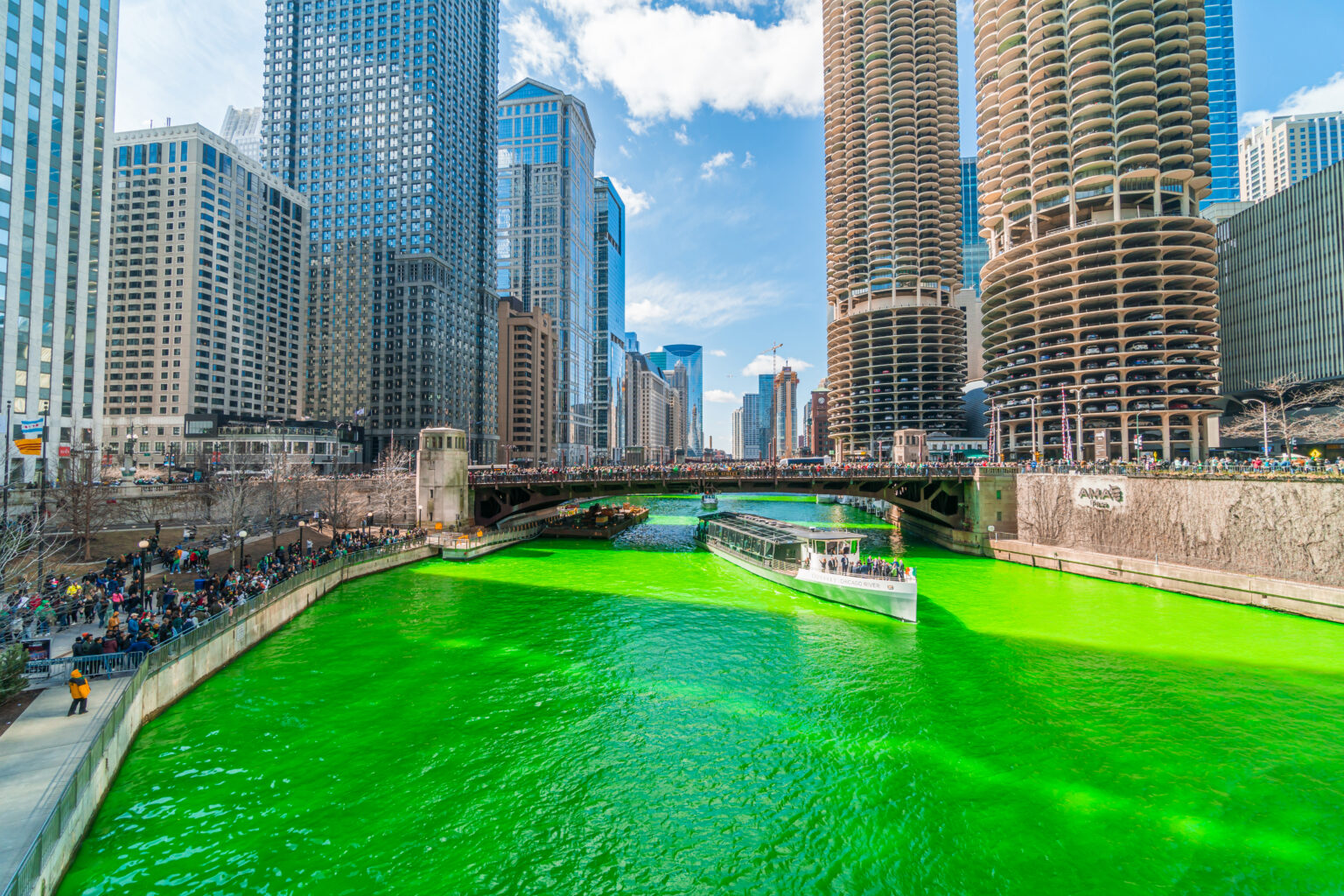
Chicago is easy to misunderstand because the city looks so young on paper. Its great explosion belongs to the nineteenth century: canals, railroads, slaughterhouses, grain elevators, immigrant wards, skyscrapers, organized labor, machine politics and eventually the Outfit. That version of Chicago begins almost from nothing and becomes everything in a few furious generations. Yet the map that matters is much older than the city grid. Long before there was a Chicago City Hall, the place occupied one of the most important hinges on the continent, where a short portage connected the Great Lakes drainage with the Illinois and Mississippi systems. The National Park Service has called the Chicago Portage one of the “keys to the continent,” and the phrase is almost too modest. Follow the water north and east and the route opens toward Mackinac, Detroit, the St. Lawrence and the French Atlantic. Follow it south and west and the same geographical machine opens onto the Illinois Country, St. Louis, the Missouri, the Ohio, New Orleans and eventually the Gulf. The French did not invent that system. They were shown into it by people who had been using it for generations.

That makes Chicago an unusual place to call the capital of an Irish kingdom, because the kingdom in question was never confined to Ireland and was never a conventional kingdom once it reached America. It was something that had learned to survive without a throne. Irish history had given it plenty of practice.
One of the peculiar strengths of Irish historical culture was its refusal to allow political defeat to become the end of history. Medieval and early-modern Irish scholars preserved enormous genealogical constructions in which kingship, scripture, classical history and migration were stitched together into a continuous story. Scota could connect the Irish to Egypt; Milesius connected them through Spain; royal lines reached backward into a Biblical and classical past. Modern historians quite properly separate those synthetic pedigrees from literal Bronze Age genealogy, yet that misses something important if it becomes the only thing we say about them. Genealogy in Ireland did political work. It preserved precedence, land claims, dynastic identity and the memory of legitimate sovereignty. A dispossessed family could lose a castle and still possess a pedigree. The kingdom could become portable.
This habit of looking outward was old. Irish scholars were already deeply involved in the intellectual life of Francia during the Carolingian period. Sedulius Scottus, John Scottus Eriugena and other Irish clerics appeared at continental courts, while Irish manuscripts and systems of learning circulated through the Frankish world. Scholars have even traced Irish models of kingship entering Carolingian political thought. Ireland was geographically peripheral and intellectually anything but isolated.
Centuries later, after English conquest had transformed the political situation at home, that continental connection acquired a harder military character. Catholic Ireland repeatedly looked toward France and Spain. The Spanish relationship was not merely the accident of Armada survivors washing ashore in 1588. In 1601 a Spanish army actually landed at Kinsale to support Hugh O’Neill and Hugh Roe O’Donnell against Elizabethan England. The campaign failed, catastrophically for the old Gaelic order, but it makes the geopolitical logic plain. Ireland could function as the western Atlantic flank of a Catholic European struggle against English power.
France became even more important. After Limerick in 1691, thousands of Irish soldiers and civilians left for the Continent, many entering French service in the tradition remembered as the Wild Geese. They were part of a much larger Irish migration of soldiers, priests, students, merchants and political exiles moving through France, Spain, Flanders and the Catholic world. Irish colleges preserved elite Catholic education abroad while Irish regiments preserved a military identity that no longer had an independent Irish state behind it.
That is the background against which the Ford story becomes more interesting than an exercise in family-tree collecting.
The old Irish name behind one Ford tradition is Mac Conshnámha, a Leitrim family once associated with the chiefs of Muintir Kenny near Lough Allen. Patrick Woulfe recorded Ford and Forde among later renderings of the name, apparently helped along by the mistaken belief that the Gaelic name meant something like “son of the ford.” Nineteenth-century genealogical literature then fitted the family into the immense Milesian royal scheme, carrying it through the Uí Briúin tradition back toward the legendary kings of Spain. Whether every generation in that published pedigree could survive modern genealogical scrutiny is almost beside the immediate point. By the late nineteenth century, Irish-American Fords were still circulating a history in which their name belonged to an old chiefly order, and the loss of political sovereignty in Ireland had not destroyed the family memory of belonging to it.
The stranger northern elements in some Ford pedigree traditions deserve attention for the same reason. Ireland had lived for centuries inside a Norse-Gaelic world. Dublin, Waterford and Limerick had Scandinavian histories; Norse settlers became political actors inside Ireland rather than remaining perpetually foreign raiders. A Danish or Scandinavian prince appearing inside a later Irish pedigree therefore does not automatically tell us who fathered whom in some remote century, but neither is the northern layer culturally nonsensical. Irish sovereignty had been mixing with Scandinavian sovereignty long before anyone in America began printing these genealogies.
That northern thread becomes particularly suggestive when it is followed forward into Sweden, although here we are dealing with a parallel rather than a demonstrated Ford lineage. Sweden developed one of Europe’s most openly royal forms of Freemasonry. The Swedish Rite came partly through French Masonic channels in the eighteenth century, became explicitly Christian and hierarchical, and remained intimately associated with the monarchy. Carl Fredrik Scheffer had been made a Mason in Paris before becoming Swedish National Grand Master; Duke Carl, later King Carl XIII, reshaped the system; the Royal Order of Charles XIII was created for distinguished Freemasons. Swedish Masonry made very little effort to pretend that chivalric fraternity and royal power occupied separate universes.
Even more revealing is what surrounded that Swedish esoteric world. Emanuel Swedenborg belonged as much to the world of mines, mechanics and state technology as to the mystical universe with which his name later became associated. His Daedalus Hyperboreus, founded in 1716 and devoted heavily to Christopher Polhem’s machines, discussed pumps, mechanical devices, navigation and a proposed flying machine. Swedenborg worked with Sweden’s Board of Mines. Here the supposedly separate categories of mystic, engineer, mining official and visionary collapse into the same man. In early-modern northern Europe, privileged knowledge could be spiritual, metallurgical, mechanical, astronomical and political without anybody finding the combination absurd.
That matters when the story crosses the Atlantic, because the interior of North America confronted Europeans with another world in which the boundaries between technical and sacred knowledge were not drawn where modern Americans expect them.

There were Irish people in New France surprisingly early. Records preserve seventeenth-century Irish Catholics passing through France into the French colony, sometimes assimilating so thoroughly that their names became Gallicized. Tadhg O’Brennan of Kilkenny, for example, appears in Quebec records in the seventeenth century. Irish soldiers and exiles continued to circulate within the French imperial world. The result was not an Irish colony hidden inside New France, but the important point is that “French” and “Irish” were never airtight categories there. A Catholic Irish exile could pass through France and become part of French North America generations before the famine-era Irish city appeared.
The French themselves entered an Indigenous political economy that was already continental in scale. The fur trade depended upon Native intermediaries, Native routes and Native diplomatic systems. Intermarriage turned commercial relationships into kinship relationships; French traders married Indigenous women, acquired local languages and entered family networks through which goods and information could travel far beyond effective French political control. By the early eighteenth century, mixed French-Indigenous populations had developed around places such as Detroit, Michilimackinac and Green Bay. New France therefore expanded less like a wall moving west than a web being threaded through an older web.
Chicago stood directly inside that web.
Marquette and Jolliet crossed the portage in 1673 because Native people already knew it. French traders followed the same connection between Lake Michigan and the Mississippi basin. By the eighteenth and early nineteenth centuries Chicago had become an important trading place precisely because geography had already chosen it. Jean Baptiste Point du Sable’s settlement did not create the commercial logic of Chicago; it exploited it.
This is the point where the older Native history beneath Chicago has to be restored, because without it the French-Irish argument shrinks into another European immigration story.

Travel southeast from Chicago into Indiana and Ohio and the modern landscape is littered with pieces of a civilization that nineteenth-century Americans found difficult to explain. At Anderson, the earthworks now preserved at Mounds State Park belonged to a broader east-central Indiana tradition extending through the White River country. In Ohio, the Hopewell ceremonial complexes reached a scale and geometrical precision that still seems startling: enormous circles, squares and octagons, some oriented to solar and lunar events.

High Bank appears to encode the complicated lunar standstill cycle; Hopeton contains a winter-solstice alignment; the Ohio complexes show engineering plans repeated across immense structures. These were gathering places built through mathematics, astronomical observation, labor organization and ritual purpose.
Then look north.
Indigenous miners had been extracting native copper in the Lake Superior basin for thousands of years. Keweenaw and Isle Royale contain some of the world’s oldest known metal-mining landscapes. Copper was hammered, annealed and made into axes, adzes, awls, knives, spear points and ornaments, then carried through exchange systems far from its geological source. Hopewell ceremonial centers in Ohio received Lake Superior copper and transformed it into sacred objects.

The old nineteenth-century temptation was to respond to this by inventing vanished Phoenicians, Hebrews or some other Old World master race capable of giving Indians civilization. That produced a cottage industry of false antiquities, from supposed Hebrew objects in Ohio to the notorious Michigan relics. Yet the irony is that removing the imaginary Phoenician makes the story more impressive rather than less. Indigenous people had found one of the world’s extraordinary native-copper deposits and developed a technical culture specifically suited to it. They did not need Mediterranean smelting furnaces because the geology gave them metallic copper of remarkable purity.
And copper did not remain merely technological. One of the strangest historical accounts from the Lake Superior region describes Ojibwe people carrying pieces of copper in medicine bags, carefully wrapped, inherited from father to son, and invested with extraordinary power. The National Park Service now uses that testimony in interpreting the ancient copper landscape. Here metallurgy, ancestry, medicine and sacred custodianship occupy the same object.
That puts the Midewiwin in a different light.

The Ojibwe Grand Medicine Society possessed actual degrees of initiation, purpose-built ceremonial lodges, restricted teachings, medicine objects and pictographic records preserved on birch bark. Walter Hoffman’s nineteenth-century study recorded four degrees. A later Smithsonian study described a Mide lodge roughly two hundred feet long, with poles, stones, entrances and fires arranged through its interior. Smithsonian collections still contain birch-bark initiation and mnemonic records; one museum catalog card says with extraordinary simplicity that its Grand Medicine Chart “contains 1st and 2nd degrees.” They are Midewiwin degrees, of course, not Masonic degrees, but the language is striking because the institutional resemblance was striking to people encountering it.
George Copway makes the comparison impossible to dismiss as something white Masons invented entirely on their own. Copway, an Ojibwe writer and former Methodist missionary familiar with the Midewiwin world, explicitly compared its graded knowledge with Freemasonry and later became a Freemason himself. Lodge records place his initiation in Federal Lodge No. 1 in Washington in June 1848. By the mid-nineteenth century, Indigenous initiation and Euro-American Masonry were no longer merely abstract parallels; individual people had begun moving between the two intellectual worlds.
Calling that “Native Freemasonry” too quickly would erase the very thing that makes it important. The Midewiwin did not need medieval European stonemasons to supply it with the basic technologies of initiation. It already possessed a lodge, grades, ritual passage through space, controlled knowledge, cosmological imagery, healing specialists and sacred objects. The question becomes more interesting once European Masonry arrives: what does one initiatory culture recognize when it encounters another?
The same problem follows the plant traditions. Northern Blackfoot ceremonial bundles collected by the Smithsonian contain native tobacco and, in one remarkable example, an actual pouch of tobacco seeds used in a planting ceremony. The bundle preserved a physical seed line together with ritual objects and the authority surrounding its cultivation. Sacred knowledge could therefore include control over the reproduction of a plant itself.

That is worth remembering when old American sources begin throwing around phrases like Indian tobacco, medicine, sage, kinnikinnick and Indian hemp. “Indian hemp” often referred to Apocynum cannabinum, a native fiber plant rather than Cannabis. Yet true hemp also entered French North America early. Jean Talon was actively distributing hemp seed in New France by 1666, even requiring growers to return seed for redistribution. There is presently no secure document showing that seventeenth-century Ojibwe medicine societies adopted Cannabis as a sacrament, and it would be reckless to pretend there is. What does exist is the machinery through which such an adoption could have happened: French hemp seed moving into a colonial economy that depended upon Native exchange, combined with Indigenous societies that already possessed ritual smoking, sophisticated pharmacology, seed custody and restricted medical knowledge. That possibility deserves investigation rather than either belief or dismissal.
It also helps explain why nineteenth-century occultists found Native medicine societies so easy to translate into the language of ancient mysteries. Europeans had their own traditions connecting temples, chivalric orders, alchemy, sacred plants, degrees and hidden knowledge. By the nineteenth century Rosicrucian and Masonic writers were actively searching for fragments of a primordial religion almost everywhere they looked. America offered them earthworks aligned with the heavens, ancient copper mines, sacred medicine bundles and Native initiatory societies using degrees and mnemonic diagrams. They did not need to fabricate the strange features. Their error was often in assuming that resemblance automatically meant European ancestry.

The older Atlantic legends found new life inside exactly that intellectual environment. St. Brendan’s western voyage, Hy-Brasil, Henry Sinclair, Mi’kmaq contact traditions, Madoc and the supposed Welsh Mandans all became pieces of an argument that Europeans had reached America before Columbus. They are not equal historically. Some belong firmly to legend, some to much later reconstruction, while Norse presence in North America is archaeologically established. What matters for this story is the persistence of a European memory in which the western Atlantic had never been an absolute wall. Irish learned culture in particular had spent centuries populating the ocean with islands, voyages and displaced peoples. America gave those stories somewhere enormous to land.

The nineteenth century then produced something even stranger: new American religions and secret political societies attempting to explain or possess the continent’s buried antiquity.
Mormonism emerged in the very region where mound-builder speculation had become an obsession. Its scripture imagined the Americas as the stage of large civilizations, migrations, wars, sacred records, political collapse and monumental history. That does not make the Book of Mormon an archaeological handbook. It does make Mormonism part of an American intellectual moment in which the deep past of the continent seemed suddenly open and mysterious. Nauvoo then added a temple, a militia, elaborate ritual life and a direct encounter with Freemasonry. When Mormon settlement later reached Cardston, Alberta, it arrived beside Blackfoot sacred country.

The geographical coincidence there is almost perfect enough to be fiction. Chief Mountain, Nínaiistáko, rises inside Blackfoot sacred geography near the Waterton-Glacier country. Just north of the international boundary, Cardston became a major Latter-day Saint center. In 1911 Freemasons there organized Chief Mountain Lodge No. 58. The official history of the Grand Lodge of Alberta itself describes Cardston as destined to become a hub of the Latter-day Saints while recording the creation of Chief Mountain Lodge. Whatever one eventually makes of the later Templar-vault stories attached to Montana and Native custodianship, the underlying institutional overlap is real: Blackfoot sacred landscape, Mormon settlement and a Masonic lodge named for the sacred mountain occupying the same small piece of the continent.

The Knights of the Golden Circle belong to another part of this same nineteenth-century appetite for continental scale. Their very name transformed political expansion into an almost cosmological geometry. Their program looked southward through Mexico, the Caribbean and Central America, imagining a vast slaveholding sphere under Southern control. There is no need to turn the KGC into guardians of an ancient Native empire to notice something revealing in the map. American secret societies and political movements repeatedly imagined sovereignty in forms much larger than state boundaries, and Mexico—where the Spanish capital literally sat on top of Tenochtitlan—offered the most dramatic American example of one civilization occupying the sacred and political center of another.
Chicago would eventually perform a similar act of superimposition, though its buried city was not made of dressed stone. It was made of routes.
The French commercial world that developed around the Great Lakes did not disappear when the French flag came down. Its political boundaries changed much faster than its geography did. The St. Lawrence still opened into the lakes. Mackinac still controlled passage between them. Detroit remained a gate. Chicago still provided the transfer between Lake Michigan and the Mississippi watershed. The Wabash, Ohio, Illinois and Missouri still carried people and goods toward the interior and the Gulf. Native families remained connected across borders that European governments repeatedly redrew. Traders changed national allegiance more easily than rivers changed direction. What had begun as a French imperial economy therefore survived in fragments under British and then American rule, and one of the least romantic commodities moving through it became one of the most politically revealing: alcohol.
The French brandy trade had never been simply a matter of drunkenness. It sat inside the fur economy, diplomacy, gift exchange, military supply, private commerce and the recurring struggle between missionaries, traders and colonial authorities over who had the right to regulate life in the interior. Under American rule, whiskey occupied much of the same practical space. It was easier to produce locally, traveled well, could be taxed, traded or smuggled, and increasingly connected frontier commerce with federal revenue. By the nineteenth century whiskey was not merely moving through the western country; the government itself had become financially interested in knowing where it moved, who distilled it, who warehoused it, who transported it, and whether the tax had been paid.
That matters because the political history of whiskey follows almost the same transformation as the political history of the interior itself. A commodity once exchanged along Native and French trading routes became an American industrial product moving through canals and railroads, yet the human problem remained remarkably familiar. Someone had to know the producer, the warehouseman, the transporter, the inspector, the banker and the official. Somewhere between the law and the barrel stood a chain of personal relationships. The Whiskey Ring would eventually expose this on a spectacular scale, but it did not invent the underlying world. It revealed how easily modern bureaucracy could become entangled with an older politics of brokerage.
Indiana belongs much more centrally to that history than it usually appears to. The Wabash country is precisely where the old continental system becomes visibly modern. French and Native routes remain underneath the map, but on top of them appear canals, plank roads, railroads, telegraph lines, grain warehouses, mills, banks, courthouses and lodges. The transportation technology changes while many of the important places do not. A settlement that once mattered because it sat near a river crossing could later matter because the canal followed the river, then because the railroad followed the canal country, then because the telegraph followed the railroad. What looks like nineteenth-century development often turns out to be the mechanization of a much older geography.

Chicago gave those habits a completely different environment in which to operate, because here political territory was still being created almost as quickly as newcomers could occupy it.
The speed of Chicago’s growth matters. In an old European city, institutions were inherited along with the streets, property lines and offices that contained them. Chicago was being assembled while its population was exploding, which meant that the people who could organize neighborhoods quickly acquired a kind of power that was difficult to reproduce once the city hardened around them. A parish was therefore more than a church in the narrow sense. It marked a population, kept marriages and baptisms, raised money, educated children, sponsored societies and gave recent immigrants an address inside a city that might otherwise have treated them as interchangeable labor. A saloon could perform a similarly practical function without resembling a church at all. It provided information, credit, introductions, employment leads, political meetings and a place where favors could be negotiated face to face. Fraternal societies supplied burial insurance, mutual aid and another layer of trust. The ward organization eventually learned to work through all of them.
Calling that system “clannish” only sounds insulting if clan is reduced to crude nepotism. Historically, a clan is a method for extending kinship beyond the immediate household and making political obligation personal enough to survive weak or hostile institutions. Chicago’s Irish population did not recreate medieval Gaelic society on Lake Michigan, but people who arrived with a strong culture of family obligation, parish loyalty, political memory and association found themselves in a city where those habits were unusually useful. A man did not have to know City Hall in the abstract if he knew someone who knew the alderman. He did not have to understand municipal hiring if his parish or lodge contained the person who could put his name forward. The city could be enormous while remaining politically navigable through small circles of acquaintance.
That helps explain why Irish influence became so durable in occupations such as policing, firefighting and municipal service. These were not merely jobs. They placed men inside the daily machinery of the city while allowing family and neighborhood ties to remain useful. A policeman knew the streets through which he walked, the saloon keepers, priests, landlords, shopkeepers and families living above storefronts. Firemen lived in another kind of brotherhood in which personal trust had obvious value. The political machine did not need to invent loyalty from nothing when it could recruit from institutions already built around it.
The same principle operated through Irish nationalist organizations, although their horizon extended far beyond Chicago. Fenianism and Clan-na-Gael carried the politics of Ireland into American cities without requiring their members to choose neatly between Irish nationalism and American municipal life. A man could work for an American city, vote in American elections, participate in an American lodge or union and still regard the political condition of Ireland as unfinished business. Those overlapping allegiances taught generations of activists how to maintain organizations across borders, raise money through dispersed chapters, communicate through trusted intermediaries and keep political goals alive even when no recognized Irish government existed to direct them.

There is something important in that arrangement that the usual story of ethnic machine politics misses. Irish political organization in Chicago was not simply a product of poverty and immigration. It was also the urban expression of a people with unusually long experience carrying political identity outside the framework of a sovereign state. The Irish had spent centuries maintaining institutions under governments they did not necessarily regard as legitimate expressions of Irish sovereignty. Churches, schools, families, secret societies, military exile communities and political brotherhoods had repeatedly performed work that a national government could not. Chicago supplied a different government and a different political opportunity, yet the underlying talent for building power through association remained useful.
The word kingdom begins to make sense here without requiring an actual king. The point is not that Irish Chicago secretly constituted a monarchy. It is that political authority could be distributed through a social order that behaved more like a network of households, retainers and local custodians than like the clean bureaucratic hierarchy shown on a city chart. A ward boss might have an official title, but the title alone did not explain his power. His strength depended upon the density of relationships beneath him: priests, businessmen, policemen, saloonkeepers, contractors, labor organizers, lawyers, newspaper men and families who remembered who had helped them when help was needed.
That relationship between assistance and loyalty was particularly powerful in a city filled with people whose security could disappear quickly. A job lost after an injury, a husband killed at work, an arrest, a problem with a landlord, a funeral that had to be paid for or a son looking for employment could become political events because the machine had learned to intervene at precisely the level where formal government often seemed distant. Patronage was corrupt when viewed through the ideal of an impersonal civil service, but it could also feel like social insurance to the person receiving it. The political organization acquired loyalty because it made itself useful in ordinary life.
The saloon occupied a much stranger position in this world than the usual language of machine politics suggests. It sold alcohol, certainly, but it also gathered functions that modern society prefers to place in separate buildings. A man could hear political news there, meet the person who might find him work, borrow money, cash a check, learn who had been arrested, arrange for a lawyer, collect money for a widow, encounter a ward operative, join a club, gamble, negotiate a favor, hear a rumor and discover which man actually possessed influence on the block. The proprietor knew who owed money, who had a job, who had lost one, who drank too much, whose brother was a policeman and which politician would appear before an election. The saloon was consequently neither simply a bar nor simply a political headquarters. It was one of the places where the neighborhood learned itself.
There is a deliberately provocative way of describing it that becomes useful after everything we have already encountered in the Great Lakes: the saloon was a kind of whiskey lodge.

That comparison does not require the Irish tavern to descend from the Midewiwin lodge, and the two institutions obviously served radically different cultures, yet placing them beside one another reveals something about social architecture. In the Ojibwe world, medicine, ceremonial smoking, restricted knowledge, teaching, degrees of initiation, healing and trusted custodianship could be concentrated within a bounded lodge environment. The long structure created a social interior in which ordinary relationships changed because those inside it participated in a particular body of knowledge. The medicine bundle carried authority into that space, and the pipe helped mark relations among people, spirits and instruction.
The Chicago saloon organized another kind of interior. Its central substance was alcohol—literally the spirits of the Western tavern—and around it developed systems of introduction, recognition, sponsorship, information and obligation. A newcomer learned whom to approach. Regulars learned which conversations belonged at which table. Political candidates entered when they needed the neighborhood. Ward workers knew which proprietor could deliver twenty men and which could deliver two hundred. People who possessed no formal office could nevertheless become indispensable because the room itself acted as a junction between worlds that were officially separate.
Calling it a whiskey lodge therefore does not mean giving the saloon a fabricated occult ritual. It means noticing that the tavern reproduced one of the oldest political functions of the lodge or longhouse: it made a large society small enough to govern through personal recognition.
That distinction matters because Irish Chicago was emerging from a culture in which the formal state had often been only one layer of political reality. Irish nationalism survived because political identity could reside in places smaller than a state and networks larger than a county. Parish, family, brotherhood, exile society, regiment, lodge and political club could all preserve allegiance without possessing internationally recognized sovereignty. Chicago offered a city in which those forms of affiliation could stop functioning merely as defensive memory and begin exercising practical government.
The ward made that possible.
A Chicago ward was technically an electoral district, yet the mature ward organization could behave much more like a small polity nested inside the larger municipality. It had territory, officeholders, political workers, businesses dependent upon its favor, police relationships, patronage, voting blocs and institutions through which residents sought assistance. Chicago had possessed an unusually segmented municipal structure from early in its history; scholars of nineteenth-century Chicago have described districts in which local property holders and ward institutions exercised considerable control over their own immediate communities, while later machine politics retained powerful ward-level organizations capable of distributing jobs and contracts.

Thinking of the ward as a microstate clarifies several things that become confusing when machine politics is described only as corruption. The alderman was a legislator on paper, but ward power extended well beyond casting votes in council. Someone had to arbitrate disputes among local interests, determine whose request for employment received attention, negotiate with downtown, know which saloonkeepers were reliable, keep peace among rival factions and deliver enough votes that the larger city organization could not afford to ignore the district. The ward possessed no formal foreign policy, but its boss negotiated constantly with neighboring political territories and with the larger municipal government. It possessed no independent treasury, yet patronage and contracts distributed resources. It possessed no army, yet police, firemen, labor organizations, street men and neighborhood toughs could provide several different forms of coercive power.

Chicago’s early fire companies make that political structure unusually visible because, before the professional department, the city’s firefighting organizations possessed much of the character of neighborhood fraternities. The companies elected their own officers, socialized together, appeared publicly in parades and maintained strong internal identities. Chicago had more than thirty volunteer companies by the 1840s. When the city introduced steam technology and moved toward professionalization in 1858, the volunteers understood perfectly well that a machine called the Long John threatened more than their preferred method of extinguishing fires. It threatened their institution. The resulting confrontation became so severe that volunteer companies marched through the streets with their engines, gathered at City Hall, confronted Mayor John Wentworth and were met by police arrests; a later city history remembered the episode as the “war of the hand engines.”
That episode looks remarkably different once the volunteer company is understood as a local brotherhood instead of obsolete firefighting technology. The hand engine belonged to the men who physically hauled and operated it. Their company elected leaders, created social prestige and gave members a collective identity. The steam engine shifted power toward capital, municipal ownership, salaried employment and centralized administration. The city was effectively taking a civic function that had been performed by armed, competitive neighborhood fraternities and turning it into bureaucracy.
A revealing version of the same struggle played out on a much smaller scale in northern Indiana, where the old canal settlement of Lagro and the rising town of Wabash found themselves on opposite sides of a profound change in how local power worked. Lagro had grown with the Wabash and Erie Canal and had developed a strong Irish-Catholic social world around St. Patrick’s, canal labor, familiar families and the older missionary corridor. Authority there was intensely personal. Men knew who worked the locks, who hauled freight, who supplied the parish, who handled funerals, which families needed help and which local figures could settle a disagreement without ever involving the courthouse.
When the canal began to decline after the Civil War, that world was not merely losing a transportation system. It was losing the economic structure around which much of its community had organized itself. Only a few miles away, Wabash was rising through rail connections, county government, newspapers, banks, commercial property, insurance and the concentration of records and legal authority around the courthouse. The two towns therefore began to represent very different versions of the future. Lagro still rested heavily upon kinship, parish, labor and the old water route; Wabash increasingly represented rail, paper, property and centralized civic institutions.
The resulting bitterness could acquire something of the character of a small Irish civil war because the men involved were not strangers divided by hundreds of miles. They occupied the same county and often moved through overlapping social worlds while disagreeing over which town, which economy and which set of institutions would inherit the future. Canal families could see the decline of Lagro as the destruction of something their parents had physically built, while men investing in Wabash could see the old water system as an obsolete obstacle to the rail-and-courthouse order taking shape around them. Labor grievance, parish loyalty, local pride and postwar political resentment could therefore fuse together very quickly.
Fire acquired particular significance inside that kind of conflict because destruction and reconstruction were never politically neutral. Burning a commercial block could erase businesses, records and property arrangements, but rebuilding could also redirect investment, change building materials, generate insurance settlements and move civic life toward a different center. The question was not simply who started which fire. The more interesting point is that communities undergoing this kind of transition could interpret fire as an attack upon the social order itself.

Chicago’s volunteer-company battles reveal the same principle at metropolitan scale. The fight over professionalization and steam equipment was not merely a technical disagreement about the best way to extinguish flames. The volunteer companies had their own officers, traditions, rivalries and neighborhood identities. When the city centralized firefighting, it took a civic function that had been performed through semi-independent brotherhoods and placed it inside a professional municipal department.
What happened afterward matters even more. The social world that had supported the old companies did not simply vanish. Irish families and political networks became deeply rooted in the paid police and fire departments that followed. A form of neighborhood authority that had once existed partly outside municipal government migrated inside it. The uniform changed the legal status of the institution without necessarily eliminating the relationships among the people who inhabited it.
That transition helps explain why the Chicago machine cannot be understood as bureaucracy replacing clan politics. The city repeatedly absorbed older forms of personal organization and gave them official functions. Firemen became municipal employees while remaining neighborhood men. Policemen carried city authority while depending upon political sponsorship and local knowledge. Ward workers acquired formal or semi-formal positions. Saloonkeepers linked voters to politicians. Contractors converted public works into jobs and jobs into loyalty. Fraternal societies and nationalist organizations supplied networks of men who already knew whom they trusted.
Chicago therefore became modern without becoming politically impersonal.
Michael Cassius McDonald appears much differently inside that structure. “King Mike” was neither simply a gambler nor simply an early mobster who happened to know politicians. He occupied a position for which the formal city had no adequate title. His gambling interests supplied money and connections, but his larger power came from his ability to influence candidates, maintain relationships with police and political figures and coordinate factions that were otherwise distributed across the city.

The nickname King Mike was revealing precisely because everybody understood that the power being described exceeded ordinary office. Chicago possessed elected mayors and aldermen, yet the city was producing another kind of executive authority above the ward structure. McDonald could influence who governed without needing to become the constitutional head of government himself.
That makes more sense once the ward is treated as something closer to a microstate than a mere election district. A strong ward had territory, political workers, businesses, clubs, churches, saloons, policemen and families whose interests had to be negotiated locally before they could be assembled into a citywide coalition. A ward boss did not simply turn out votes. He acted as an intermediary between the neighborhood and the larger city, deciding which requests would travel upward and translating downtown power back into jobs, favors, licenses, contracts and protection.
The citywide boss occupied the level above those local authorities. His value lay in recognizing their power rather than destroying it. He assembled factions, brokered disputes, helped determine acceptable candidates and created enough agreement among otherwise independent political territories for the organization to act as a whole.
In that sense the office could become almost presidential.
The comparison is political rather than constitutional. Chicago’s wards were not sovereign states, yet they possessed enough internal political life that the person capable of coordinating them acquired a different kind of authority from the mayor whose powers were written into law. The unofficial boss worked through leaders who already controlled smaller territories, much as a federal executive works through institutions and political interests that retain power of their own.

The later Chicago Outfit would develop a surprisingly similar executive problem. Its boss did not personally operate every gambling business, liquor route or protected enterprise. Territorial crews and individual operators retained their own interests and internal authority. Someone above them became useful because disputes had to be settled, boundaries recognized, relationships approved and the organization represented to outsiders.
The similarity does not mean the Democratic machine simply turned into the Outfit. It means Chicago had spent decades developing a political culture in which unofficial executive power could arise above semi-autonomous territories. The city had learned to live with two maps of authority at once: the official one of City Hall, courts and departments, and the social one of wards, political families, saloons, police relationships, contractors, gamblers and neighborhood intermediaries.
The person capable of connecting enough of that second map could exercise something resembling sovereignty without occupying the office that supposedly contained it.
European imperial politics offers a useful analogy because large composite states had long faced the same practical problem. The Habsburg monarchy could not turn every province into a culturally identical extension of Vienna, nor could the emperor personally govern every local community. Authority depended upon intermediaries who knew regional politics, managed local loyalties and translated the interests of the center into forms local elites could accept. It was the people in government figuring out what the best version of a ‘state’ could be.

Galicia provides a particularly useful example. Polish elites could retain their own political culture and considerable regional influence while still functioning within the imperial framework. Vienna did not have to abolish every local identity to maintain the larger structure. In many circumstances it governed more effectively by recognizing those identities and negotiating through the people who commanded them. Franz Joseph was obviously not a Chicago ward boss, just as King Mike was not a miniature emperor, but the structural resemblance helps explain the office. Both systems depended upon local authorities remaining powerful enough to govern their own territory while still being tied to a larger center. Information moved upward through intermediaries. Recognition, appointments, protection and favors moved downward.

Prague offers another useful comparison because urban life there existed inside a similarly layered political world. Czech, German, Jewish, imperial and municipal identities could inhabit the same city without resolving neatly into a single culture. Chicago developed its own version of that problem as Irish, German, Czech, Polish, Jewish, Italian and other communities created parishes, clubs, newspapers, businesses and political associations that allowed them to participate in the city without surrendering their identities immediately.
Ward politics made this diversity governable because it gave difference a territory. Instead of expecting every immigrant to relate directly to an abstract municipal state, the machine allowed politics to remain legible at neighborhood scale. People knew their local organizations. Local organizations knew their ward. Ward leaders negotiated with the larger party. Citywide bosses negotiated among the ward leaders. Chicago begins to look less like a single political pyramid than an urban federation.
Power moved in both directions. A ward could bargain upward because it possessed votes. Downtown could reward a cooperative ward through jobs and contracts. A saloonkeeper could matter because he knew fifty men whom an alderman did not. A police captain could alter the local political economy merely by deciding which laws would be enforced aggressively. Firehouses mattered because the men inside them belonged simultaneously to the city and the neighborhood.
The ‘whiskey lodges’ (pubs) occupied a particularly useful position inside that arrangement because it connected ordinary life to politics without requiring either side to announce what was happening. The saloonkeeper did not need a municipal title to possess valuable information. His room generated it every night. People discussed jobs, arrests, marriages, arguments, debts, politics and business because that was where they already gathered.
Political organization therefore grew around an institution whose primary economic function financed its social one.
The darker uses of that intimacy followed naturally. The proprietor who knew who needed groceries could also know which policeman took money. A back room could host a ward meeting on one night and gambling on another. Campaign contributions and funeral collections could pass through the same hands. Respectability and criminality did not always occupy different addresses.

Organized crime developed inside those ambiguities rather than arriving later to infect an otherwise clean political city. McDonald’s gambling world, the First Ward vice structure and eventually the Prohibition syndicates all depended upon accommodations with formal government because illicit businesses could not function indefinitely without some relationship to police, licensing, courts and political protection.
Italian and Sicilian organizations later became dominant in Chicago organized crime, but they entered a city whose political ecology had already been shaped by decades of vice brokerage, ward politics and personal government. The Outfit did not need to invent the relationship between illicit commerce and municipal authority. It inherited a city that already understood it.
Whiskey makes that transition especially visible. Under New France alcohol had moved through trade and diplomacy. Under the United States it became a frontier commodity and a taxable industrial product. In Chicago it financed the neighborhood saloon. Under Prohibition it became contraband valuable enough to finance large criminal organizations.
What remained remarkably consistent was the political infrastructure that gathered around it: distribution, territory, taxation, licensing, protection, credit and intermediaries who could move between the legal and illegal worlds.

The Whiskey Ring of the Grant era fits naturally into that longer history because federal revenue policy attempted to make the movement of alcohol legible to Washington. Distillers, warehousemen, revenue officers and political operators discovered that bureaucracy could itself be manipulated through relationships. The federal government created stamps, records, inspections and bonded warehouses; the people inside the system discovered whom they needed to know.
The paperwork became modern faster than the politics did.
Chicago multiplied the same problem across almost every commodity moving through the city. Grain required elevators, brokers and exchanges. Livestock required stockyards and rail connections. Lumber, coal, meat and manufactured goods traveled through specialized commercial systems. Political power developed in a city where virtually everything depended upon coordination among networks that no single person completely controlled. The machine performed the same work with people. Immigrant neighborhoods became voting blocs, voting blocs became offices, offices produced employment and contracts, those benefits produced loyalty, and loyalty returned to the machine as votes. The process looks mechanical only from a distance. Up close it was intensely personal because every conversion occurred through somebody who knew somebody else.
A ward boss consequently functioned as a translator between private life and public authority. Residents approached him because municipal government could feel remote or inaccessible. Downtown politicians approached him because he knew which local factions actually mattered. He decided which problem needed attention, which person could be trusted, which favor would purchase lasting loyalty and which grievance might cost the organization an election.
Someone such as McDonald occupied the level above the translators.

The presidential quality of the office becomes clearest there. He did not need to know every voter personally because his authority depended upon knowing the people who did. A national executive governs through layers of institutions rather than personal acquaintance with every citizen; the unofficial Chicago executive governed through ward leaders, political intermediaries and people who controlled pieces of the city’s social geography.
The later Outfit boss confronted almost the same organizational problem in criminal form. He did not personally know every customer, bookmaker or driver. He dealt with the people who controlled those operations. His power rested partly on the ability to arbitrate among them without abolishing the independence that made each local operation effective. Chicago repeatedly generated this structure because Chicago repeatedly generated federations.
Volunteer fire companies formed a federation of neighborhood brotherhoods performing a public service. Ward politics federated local political territories. Irish nationalist organizations linked American chapters to a transatlantic cause. The city itself federated ethnic communities that maintained their own churches, newspapers and clubs. Organized crime eventually federated territorial crews and enterprises.
The organizations were not the same and did not descend neatly from one another. What repeated was the political problem: how to coordinate semi-autonomous groups without destroying the relationships that made them useful. That is why the Habsburg analogy works better than a simple comparison with a modern centralized state. Imperial government often relied upon layered loyalties rather than attempting to erase them. Chicago’s machine did something comparable at urban scale. The city became governable precisely because neighborhoods were permitted to retain distinct political identities while brokers connected them to a larger organization.
Irish political culture proved particularly adaptable to that environment because layered allegiance was already familiar. A man could be loyal to his family, parish, political brotherhood, American city and Irish national cause without feeling that every allegiance had to collapse into one identity. Fenianism and Clan-na-Gael demonstrated the point dramatically: Chicago politicians and municipal employees could participate fully in American civic life while remaining committed to the unfinished political future of Ireland.

That experience had taught generations of Irish political actors something the idealized bureaucratic state tries to forget: sovereignty does not have to occupy one institution at a time.
It can be distributed.
A parish can preserve one part of it. A family can preserve another. A secret society can preserve political commitment. A newspaper can preserve memory. A ward can exercise territorial power. A political boss can coordinate several of those institutions without legally owning any of them. Chicago turned that dispersed political instinct into municipal government. The reversal is important. For centuries Irish institutions had helped preserve political community after the destruction of sovereignty. In Chicago the same general capacity for association could be used to construct sovereignty out of communities that already existed.
The ward was therefore more valuable than a castle because it translated belonging directly into votes. A successful political family did not need hereditary legal title if it could inherit relationships. A son could inherit introductions, reputation, neighborhood loyalties and an understanding of how the organization worked. Fire, police, law, contracting and politics could all develop familial continuities without becoming literal hereditary offices. That gave Chicago politics its dynastic texture.
It also helps explain why corruption alone is too shallow a description of the system. Personal government could produce bribery and protection, but it could also find somebody a job, pay for a funeral, intervene with a landlord or help a family navigate a city bureaucracy that otherwise offered them little assistance. The same discretion that permitted abuse made the organization useful. The machine survived because enough people experienced both sides.
The older Native and French history beneath Chicago makes the arrangement more interesting rather than less. Long before an Irish ward existed, the Great Lakes had been governed through overlapping systems of kinship, trade, diplomacy and ceremonial authority that ignored the clean political boundaries Europeans later attempted to impose. French traders adapted to Native networks because they had no realistic alternative. Kinship and commerce became entangled. Métis communities emerged. Strategic places remained important across changes of sovereignty because geography survived every flag planted over it.
Chicago was one of those places. Long before it became an industrial metropolis, the site already mattered because Native travelers understood the passage between Lake Michigan and the Illinois-Mississippi system. The French entered that geography rather than inventing it, and the Americans later enlarged it with canals, railroads, warehouses, grain elevators and telegraph lines. Each new technology increased the volume and speed of movement without changing the fundamental reason the place mattered. Chicago was valuable because different worlds met there, and by the nineteenth century the city had become an enormous mechanical version of the older portage.
That transformation occurred at the same time Americans were discovering just how complicated the history beneath the Midwest actually was. Ancient copper mines around Lake Superior, monumental earthworks through Ohio and Indiana, astronomical alignments, Native medicine societies and surviving ceremonial systems all challenged the convenient idea that the interior had been an empty stage waiting for American development. Railroads were cutting through ancient landscapes while antiquarians excavated them; federal authorities were suppressing ceremonies while ethnographers hurried to record what they could; physicians routinely dismissed Native healers even as commercial medicine absorbed plants and treatments learned from Indigenous practice. The modern Midwest was being built partly by erasing an older intellectual world and partly by taking pieces of that world into itself.
Chicago concentrated these contradictions with unusual force because almost nothing in its later history actually replaced what had come before as cleanly as the usual story suggests. The Native crossing became the French portage; the portage was enlarged by the canal; the canal geography was overtaken and expanded by the railroad; the railroad city became an immigrant metropolis; immigrant neighborhoods hardened into wards; wards became the foundation of the machine; and the same political landscape later proved capable of supporting a criminal organization whose territories often ran beside, through and underneath the legal city. These were different systems with different purposes, yet each one depended on understanding how people, information and goods moved across the same strategic ground.
The lodge comparison is useful here because it allows us to see how much of this history took place inside rooms rather than on maps. The Midewiwin lodge, the Haudenosaunee longhouse, the Masonic lodge, the Irish fraternal hall, the parish meeting room and the political saloon were never versions of one hidden institution, but all of them demonstrate the power of creating a bounded social interior where membership matters and where information travels differently than it does outside. A person knows who belongs, who has standing, who can introduce whom and which obligations have accumulated over time. Chicago’s political machine became powerful because it linked hundreds of these smaller interiors together. The saloon, parish, firehouse, police station, club and ward office were each capable of knowing a portion of the city intimately; the machine made their separate knowledge politically useful at a larger scale.
Once the city is seen that way, the strange authority of a figure such as Michael Cassius McDonald becomes easier to understand. King Mike did not have to occupy every office because his influence came from knowing the people who controlled the pieces. The mayor possessed the legal executive office, but the formal charter could not describe all of the relationships through which Chicago actually functioned. Wards had their own organizations and local interests; saloonkeepers knew neighborhoods that downtown politicians did not; police and firemen carried municipal authority while remaining tied to local social worlds; contractors, gamblers, lawyers, clubmen and political workers moved between these circles. McDonald’s importance came from standing high enough above that fragmented landscape to negotiate among people whose own power remained local. His nickname sounded monarchical because Chicago had produced a kind of authority that was plainly real but difficult to name.
The Habsburg comparison helps precisely because that empire faced a similar structural problem on a much larger scale. Franz Joseph governed a political world that contained regions with their own languages, elites, legal traditions and historical identities, and the empire could not function by pretending that Galicia, Bohemia, Hungary and Vienna were socially interchangeable. Authority had to pass through local intermediaries who understood conditions the center could never know directly. Prague was consequently capable of being Czech, German, Jewish, municipal and imperial at the same time, with those identities competing and overlapping rather than resolving into a single uncomplicated civic culture. Chicago developed something comparable in urban form. Irish, Germans, Czechs, Poles, Jews, Italians and other communities could be fully part of Chicago while maintaining churches, newspapers, clubs, businesses and political organizations that made their own neighborhoods intelligible from within.
Ward politics gave that plural city a workable political geography. It allowed local communities to retain enough internal structure to negotiate with the larger city rather than requiring every resident to face municipal government as an isolated individual. A strong ward therefore behaved less like a mere voting precinct than a political territory with its own brokers, institutions and memory. The boss knew which groups had to be satisfied, which feud needed quieting, which family carried influence, where jobs mattered, which club could mobilize men and how many votes the district could actually deliver. Downtown government could issue orders, but it still required people who knew what those orders meant once they reached a particular street. The machine grew in the distance between those two kinds of knowledge.

That is what gives the later Outfit its unmistakably political shape without requiring us to pretend that the Democratic machine simply transformed into organized crime. The Outfit emerged in a city that had already spent decades learning how unofficial authority could coexist with official jurisdiction. Territorial crews, bookmakers, gambling houses and liquor networks needed relationships with police, politicians, lawyers and legitimate businesses, and the boss above them acquired value because somebody had to settle disputes between interests that could not safely settle every disagreement by force. The executive quality of the position came from arbitration as much as intimidation. A boss who controlled nothing except his own immediate racket was merely a successful criminal; the man who could recognize territories, negotiate among powerful subordinates and speak for the larger organization occupied a different kind of office.
Prohibition enormously increased the money available to that system, but alcohol had been entangled with political authority in the interior for centuries by then. French traders had carried it through Native commercial networks; American whiskey became a taxable frontier commodity; the Whiskey Ring exposed the ease with which distillers, revenue officers and political intermediaries could bend federal administration through personal relationships; the urban saloon turned liquor sales into a neighborhood meeting economy; Prohibition then converted the same commodity into contraband valuable enough to finance metropolitan criminal power. The legal category kept changing while the recurring questions remained familiar: who controlled distribution, who collected revenue, who granted protection, which territory belonged to whom and which intermediary could reach the person who mattered.

For the Irish, Chicago offered a particularly powerful answer to a much older political problem. Irish history had repeatedly forced political identity to survive outside complete control of the state. Genealogy could preserve dynastic memory after a family lost its land; Catholic institutions could preserve community under hostile government; soldiers and political exiles could carry allegiance into France, Spain and America; secret and semi-secret nationalist organizations could organize for an Ireland that did not yet exist as the independent state they imagined. Political life consequently did not need to be concentrated in one visible sovereign institution before it could feel real.
Chicago reversed the conditions under which those habits had developed. The Irish were no longer preserving a political community after sovereignty had been lost; they were living in a rapidly growing American city where sovereignty itself was still being assembled from neighborhoods, parishes, labor networks, departments and wards. The skills that had helped maintain community under dispossession now became useful for acquiring municipal power. Family loyalty, parish connection, fraternal membership, neighborhood memory and political obligation could all be converted into votes, jobs, contracts and influence. A political family did not require a hereditary legal title when a son could inherit his father’s introductions, reputation, allies and understanding of how the city worked.
This is why corruption alone is too narrow a language for the machine. The same personal discretion that could protect gambling or steer a contract could also secure work for a laborer, help a widow, intervene with a landlord or guide a recent immigrant through a bureaucracy he barely understood. The system accumulated loyalty because it was useful, and it became corrupt for exactly the same reason: relationships could accomplish things that impersonal rules could not. The strength and the abuse were produced by the same political architecture.
By the time Chicago entered the twentieth century, almost none of the people operating that architecture needed to know how many older worlds had converged beneath it. A ward captain did not need to know the geography of New France, and a fireman did not need to know anything about the Wild Geese. The saloonkeeper whose back room functioned as a political chamber had no reason to know that Native societies around the Great Lakes had long used controlled social spaces to preserve knowledge and authority. Political institutions do not carry their entire genealogy consciously. They preserve whatever continues to work.
That is what makes Chicago such an extraordinary place to end the story. The city sits at an ancient continental hinge whose usefulness survived every political regime that claimed it. Native movement gave the geography its first known human system; French America joined that system to the Atlantic world; canals and railroads mechanized it; mass immigration filled it with peoples carrying their own histories of exile and association; the ward machine converted neighborhood identity into municipal power; and organized crime later learned to operate through the same dense landscape of territory, brokerage and personal obligation.
The title Chicago and the Irish Kingdom does not require an Irish monarchy hidden under City Hall. It describes something more historically interesting: a people whose political culture had spent centuries learning how to carry sovereignty without possessing a state finally encountered an American city where political territory was still available to be organized. The Irish did not rebuild an old kingdom in Illinois, but they helped create a city in which parish, ward, fraternity, occupation, family and political organization could be woven tightly enough that unofficial authority became almost as consequential as official office.
That was the real achievement of the machine. It could make a metropolis of strangers behave politically through relationships small enough for people to understand personally. A ward boss governed because somebody knew him; a city boss mattered because the ward bosses knew him; and a figure such as King Mike could appear almost presidential because his authority came from coordinating men who already possessed power of their own. The later Outfit boss inherited the same metropolitan problem in a darker form, governing across territories and organizations that remained locally rooted even while answering to a larger center.

Chicago did not become the capital of this kingdom because it preserved some uninterrupted medieval institution. It became the capital because an ancient crossroads and an old political culture happened to meet at the moment an enormous modern city was being invented. The geography supplied the convergence, the immigrant wards supplied the territories, and the Irish supplied a political tradition unusually comfortable with the idea that authority could remain powerful even when much of it lived outside the formal state.
That was enough to build a kingdom without a crown.