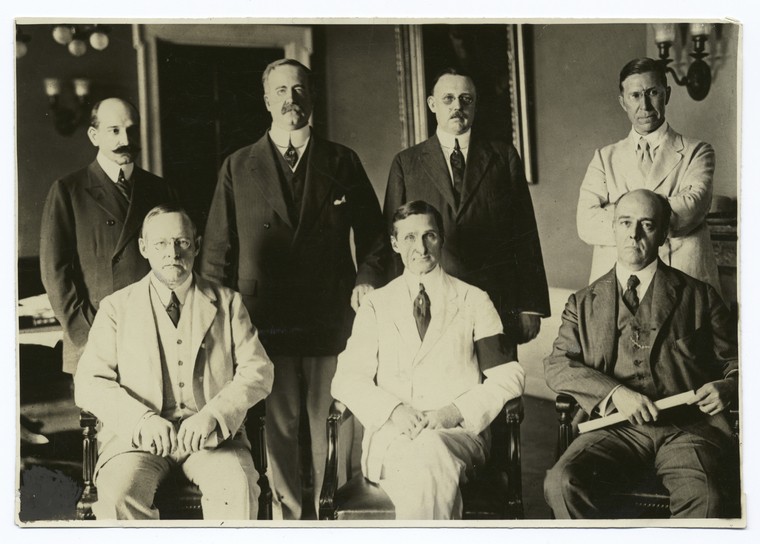
In 1926, a man whose father had made a fortune selling opium arrived in Persia to investigate how the country might grow less of it. Frederic Adrian Delano had run railroads and helped launch the Federal Reserve. Now the son of a China merchant was presiding over a League of Nations inquiry into one of the commodities that had helped make his family wealthy.
To understand how he reached that assignment, it helps to open a book published twenty-seven years earlier.
Its title was The Genealogy, History, and Alliances of the American House of Delano, 1621–1899. Compiled by Major Joel Andrew Delano and arranged by Mortimer Delano de Lannoy, it surrounded its family histories with coats of arms, royal lines, and lists of Lannoy knights of the Golden Fleece. The word house did considerable work. A name carried across the Atlantic by a young immigrant had become something its nineteenth-century descendants could present with the grandeur of a dynasty.
Franklin Roosevelt was seventeen that year. His presidency still lay more than three decades ahead, and the Delano story already stretched across Chinese trading ports, Hudson River estates, coal properties, railway offices, and banking houses. His mother, Sara, belonged to a family whose history was much larger than the famous son through whom most Americans would eventually encounter it.

The royal scaffolding deserves scrutiny before the story goes any further. The Delano Kindred’s correction of the genealogy rejects the book’s proposed bridge between the immigrant Philippe de Lannoy’s family and the aristocratic line through Jean and Gysbert de Lannoy. The family’s origins in the Low Countries survive that correction; the claimed route into the titled pedigree does not. Heraldry can tell us what the compilers wanted their readers to see. It cannot repair a broken descent.
Yet the book’s ambition was not entirely a matter of imaginary ancestors. By 1899, Delanos had made marriages and business arrangements that placed them among people with substantial power on both sides of the Atlantic. There is a more revealing history in those actual relationships: who supplied capital, who managed an estate while a relative was abroad, who sat on a corporate board, who could turn practical expertise into public authority. The surviving records allow us to follow that history without accepting the pedigree at face value.

Begin with a merchant’s son. Captain Warren Delano, born in 1779, gave his name to the Warren Delano born in 1809 who would become Sara’s father. This second Warren went to China and entered the world of Russell & Company, where American merchants handled tea and silk alongside the opium sold into China. In a letter of April 11, 1839, preserved among the family papers, he defended the opium business. He became a partner in 1840. The fortune behind the family’s later comfort therefore requires a history of the commodity and the conditions of its sale, as well as a history of the merchants’ enterprise.


Warren called the trade “fair, honorable and legitimate.” That merchant’s defense stood against Chinese attempts to restrict a destructive business. His participation was deliberate, and a description confined to tea and silk would leave out an essential part of how the fortune was made. Following that money into America becomes a more exacting task: a particular consignment or receipt must still be connected to a particular investment. The family’s later interests grew far beyond the commodity that had helped finance its rise.
Money crossed the Pacific in more than one direction. Houqua, the immensely wealthy Canton merchant, placed investments under the management of John Murray Forbes. The American Stock Investment account, or ASI, continued for Houqua’s son. Chinese wealth was finding a place in American investments through a relationship built in the trading port. Warren’s own papers preserve Houqua accounts for 1865–1867, long after the original merchant’s death in 1843. Behind the recurring name stood heirs, agents, and an account that could outlive the men who had established it.


Forbes would reappear in American railway finance and, during the Civil War, on a mission for the Union government. The trust acquired in the countinghouse could travel a considerable distance.
Warren’s own prosperity was less secure than a retrospective dynasty portrait suggests. After losses in the Panic of 1857, he returned to China in 1859. His wife, Catherine, and their children followed in 1862 aboard the Surprise. Their son Frederic Adrian Delano was born in Hong Kong on September 10, 1863. The birthplace of the future Federal Reserve official belongs to this second period of his father’s business life, when restoring a fortune meant living again near the trade that had helped make it.

Catherine’s account of the family voyage survived in a journal that Adrian brought back to attention in 1928. As historian R. J. C. Butow showed in his examination of the voyage and its later retellings, family memory had acquired an exciting encounter with the Confederate cruiser Alabama that the shipping evidence did not sustain. The journal and the logs recover a different journey. The episode is a small warning against allowing the most memorable version of a family story to become the only version.
At home, the family’s interests had already entered the ground beneath American industry. The Delano family papers preserve Mount Savage Iron Company material from 1858–1863, followed by Union Mining Company records. Warren’s brother Franklin Hughes Delano managed interests during the China absence. The same archive carries Delano Land Company papers, while the Asa Packer collection at Lehigh supplies another approach to the family’s Pennsylvania land and business dealings. Coal, iron, land, and transport were becoming mutually dependent investments. A map of the family’s money has to run inland from the ports.
Franklin Hughes Delano was well placed to manage the work. He had been a partner in Grinnell, Minturn & Company from 1839 to 1851, giving him a commercial career of his own. In 1844 he married Laura Astor, daughter of William Backhouse Astor and Margaret Rebecca Armstrong. Their Hudson River estate, Steen Valetje, made the resulting social position visible in stone, landscaping, and a household within reach of other wealthy river families. In later years the couple spent considerable time in Europe. A real alliance had accomplished what the invented medieval bridge could only suggest.

The Astor marriage also opens a Hughes connection that can be followed through actual family relationships. Laura’s mother, Margaret Rebecca Armstrong, was the sister of Horatio Gates Armstrong. Horatio married Mary Hughes, sister of the American diplomat Christopher Hughes. Thus Christopher’s sister became the sister-in-law of Laura’s mother, and Laura married Franklin Hughes Delano. This is an extended marriage connection, with identifiable people at every step.
A January 18, 1835 letter from Margaret Astor to Mary Armstrong concerning Margaret’s brother Horatio survives in the Christopher Hughes papers. It brings the relationship down from the family chart to ordinary correspondence between women whose households had become connected. Franklin’s middle name remains a separate question. The Astor–Armstrong–Hughes marriage route can be established without making that name carry evidence it does not contain.


Beyond those households lay a Hughes career with a different kind of reach. George W. Hughes, an engineer and later diplomat and congressman, reported on Maryland’s coal country in the 1830s. His report on the coal region near Cumberland and his work connected with the Maryland Mining Company belong to the development of the same broad mineral region as Mount Savage, although the companies were distinct. His wife, Ann Sarah Maxcy, was the daughter of Virgil Maxcy, American chargé d’affaires in Belgium from 1837 to 1842. His engineering work also reached the Panama railway world. Coal surveys, transport projects, and diplomatic households make his career relevant to the industrial landscape around the Delanos. A business partnership with them, or a family relationship to Christopher, still awaits direct evidence.


The surname turns up again in a quieter but useful place: on the title page of the Forbes family’s published letters. Sarah Forbes Hughes, John Murray Forbes’s daughter, edited Letters and Recollections of John Murray Forbes in 1899. She had married William Hastings Hughes, brother of the English writer and Rugby settlement founder Thomas Hughes. The Rugby papers in Tennessee preserve that family’s correspondence. A “Hughes, William H.” entry in the Warren Delano finding aid is therefore worth identifying against an existing Forbes relationship. The initials alone cannot settle it, and none of this makes George W. Hughes, Christopher Hughes, and Judge James Hughes interchangeable members of one proven line.
Railways make the same demand for careful identification. There were two important Moreau Delanos in different generations. The older Moreau, an engineer who died in 1870, was the father of the banker Eugene Delano. Eugene’s son, also Moreau, was born in 1877 and became a Brown Brothers partner. The elder man belonged to the canal and railway generation; the grandson belonged to twentieth-century banking. A document naming one cannot be used as evidence about the other.

Even their relationship to the best-known Delano branch deserves restraint. The 1899 genealogy placed the elder Moreau under a section headed “Delano Line Unknown,” as a son of Obadiah Delano. A memorial to Eugene in Among the Deep-Sea Fishers in 1920 supplied a different-looking origin story: a Huguenot ancestor who fled at the revocation of the Edict of Nantes and eventually settled in South Carolina. That account’s chronology and destination do not match Philippe’s arrival at Plymouth in 1621. It cannot quietly be converted into proof that Eugene descended through the same established line as Sara and Adrian.
On the engineering career the memorial is more concrete: it remembers Eugene’s father as Victor Moreau Delano, involved in the Erie Canal and Croton Aqueduct. The papers of John B. Jervis offer a way to test the railway connections through business documents. Their inventory includes an M. Delano proxy dated May 10, 1855, an 1857 agreement involving John W. Brooks and Jervis, and letters from Litchfield and a Ford in December 1852. Identifying the people and transactions behind those entries could place the older engineering generation within the financial work of railway expansion.
The Ford question has a specific purpose. Ford Brothers of Cincinnati appeared in the redemption arrangements for Detroit & St. Joseph Rail Road Bank notes; an 1840 dollar note was payable to A. C. Ford and carried serial number one. Identifying the Ford who wrote to Jervis in 1852 could show whether an earlier banking and redemption business carried into the railway relationships represented in his papers. At present the letter writer’s identity, and the continuity of that business, remain unproved. The shared name is the beginning of the test.
A dollar note and a railway mortgage may seem distant from the practical work of laying track. Both addressed the same necessity: turning an enterprise’s promises into money it could use. Redemption agents stood between issuers and the people asked to accept their paper. Investors in larger systems demanded securities, trustees, and enforceable claims. By October 1873, a Chicago, Burlington & Quincy trust mortgage could set out an obligation of thirty million dollars, naming Sidney Bartlett, John W. Brooks, and H. H. Hunnewell as trustees. The sums had changed dramatically; confidence still required people and arrangements behind the printed instrument.


Brooks, Hunnewell, and Forbes belong to the history of railway development and its financial leadership. Following them shows how eastern wealth could acquire durable positions in western infrastructure. It also makes the repetition of Brooks particularly treacherous. John W. Brooks of the Burlington and Michigan Central world was not James Brooks, the early president in the Monon’s institutional ancestry. Neither name licenses an identification with James J. Brooks of the Secret Service. The distinctions matter because the railroads’ own history already contains a substantial security story without help from a mistaken identity.
In Michigan, the railroad conspiracy prosecution of 1851 exposed the company’s use of intelligence against its opponents. Accounts of the case describe agent Darius Clark’s infiltration and the gathering of evidence before mass arrests. The published trial record belongs beside corporate histories when assessing how a railway defended its property. Transport companies were large institutions with vulnerable fixed assets, dispersed workforces, valuable shipments, and adversaries. They had reasons to employ informants and investigators that arose directly from their business.
Across northern Indiana, more local forms of organized detection were taking shape. A reprinted account of a Fort Wayne meeting in 1841 places Samuel Hanna and Hugh McCulloch among the people organizing against crime. In Wabash County, the history of John Comstock’s circle describes an association formed in 1851 that accumulated more than two hundred names within a year. Indiana’s 1852 legislation allowed groups of ten to a hundred citizens to form detective companies. These were recognizable institutions of a region trying to protect property and pursue offenders across scattered communities.
Hanna Lodge’s history records Comstock’s membership and James Ford’s participation in its early organization. Businessmen and local investigators could encounter one another in these associations, although a common lodge membership does not establish operational control. Decades later, Thomas Furlong’s Fifty Years a Detective would describe his work as chief detective of the Wabash in 1883 and his service in the Gould railway system. Railway property now had investigators working within a corporate structure, a substantial development from the earlier local associations.
Adrian would eventually run the Wabash. When the Civil War began, he had not yet been born.


In 1863, John Murray Forbes and William H. Aspinwall went to Britain on Union business concerning Confederate warships and the means of frustrating their acquisition. The mission appears in Forbes’s published correspondence, with the government’s instructions and financial preparations, and in the Naval Institute’s account of the early naval attaché system. Commercial experience, credit, and overseas contacts had become instruments of wartime policy. Forbes’s China background and American railway interests formed part of the experience he brought, but his wartime instructions came from the Union government.


James Dunwoody Bulloch was working on the Confederate side of that contest, acquiring ships in Britain. His family would eventually connect to the Delano household through a very different route. Bulloch’s sister Martha married Theodore Roosevelt Sr.; their son Elliott was Eleanor Roosevelt’s father. Eleanor married Franklin Roosevelt in 1905, and Franklin was Sara Delano’s son. The marriage therefore brought the Delano and Bulloch descendants into an extended family relationship. It did not retroactively put Warren Delano into Bulloch’s wartime procurement operations.


The opposing assignments make the history more interesting than a single undifferentiated circle. A merchant trusted by Union officials and a Confederate purchasing agent could work in the same British commercial environment toward incompatible ends. Their descendants’ later marriages do not erase the conflict. Understanding an overlapping social world requires retaining the decisions and allegiances of the people inside it.
A second Civil War trail leads through Columbus Delano, who later served as President Grant’s secretary of the interior from 1870 to 1875. Grant himself had Delano ancestry through Susanna Delano and Noah Grant, a descent recorded in the genealogy. Columbus’s own importance here comes from his office: the Interior Department occupied a central place in the administration of public lands, Indian affairs, and the expansion that accompanied railways. The Library of Congress finding aid to his papers also identifies correspondence with Jay Gould. The record places him at a particular intersection of public authority and private expansion.


Among his papers is an especially suggestive item: an 1872 file about the government’s purchase of Confederate archives containing a copy of Jacob Thompson’s report to Judah P. Benjamin, dated December 3, 1864. Thompson had been operating from Canada. His report describes projects aimed against the Union, including contacts with the Sons of Liberty, attempted disruption in the North, and operations involving the Great Lakes. It is a report by a participant, with the claims and excuses that such a document can contain.


Thompson’s report entered this file through the later purchase of Confederate records. That provenance makes the connection intelligible: Columbus’s papers hold a copy of an enemy official’s account of clandestine operations. They do not hold a Thompson letter addressed to Columbus. The file puts the underground within reach of this inquiry without making its later custodian a participant.
Columbus has a separate connection to federal detection. George P. Burnham’s Three Years with Counterfeiters, Smugglers, and Boodle Carriers, published in 1875, says that Columbus, as commissioner of internal revenue, wanted to retain Hiram C. Whitley in that service when Whitley was offered leadership of the Secret Service. The account supports a contemporary claim of a working relationship. It should be read with the awareness that Burnham was telling a dramatic story about the service and its agents. There is still a considerable distance between that episode and a claim that a Delano family organization controlled federal intelligence.
The wider Prince Albert, Kerr, and Latta trail remains incomplete. Albert died in December 1861; Thompson’s Canadian mission belongs to 1864. A connection would have to run through someone who carried a relationship across those years. The British arms-making career of James Kerr belongs to a real Confederate procurement setting, but has not been joined by evidence to a Kerr family in Indiana. The Latta inquiry likewise still needs a documented route from the counterfeiting accounts or Cincinnati’s fire-engine business into the Delano records. The Thompson archival copy and the Bulloch marriage give this story points of contact with the Confederate world. They do not complete those additional routes.
Adrian’s path, by comparison, can be followed from job to job. The child born in Hong Kong grew up to study at Harvard, then entered the Chicago, Burlington & Quincy’s shops as an apprentice machinist in 1885. It was a choice that brought him into contact with the machinery and labor beneath a railway’s financial statements. He rose through operating work to become the Burlington’s general manager in 1901. By then the century’s great railway systems had become organizations whose management demanded the coordination of equipment, men, schedules, and money over enormous distances.


In October 1905, newspapers announced his appointment as president of the Wabash. Receivership followed in 1911, giving him experience with a system in financial difficulty as well as one under ordinary executive management. Then, on December 23, 1913, he became president of the Chicago, Indianapolis & Louisville, usually called the Monon. Its contemporary news reports and presidential chronology place that short tenure between the Wabash years and his departure for Washington in August 1914. In less than a year he would move from operating an established railway to helping establish an entirely new national institution.

The transition from the Monon to Washington carried a railway manager into the machinery of national credit. Adrian became one of the original members of the Federal Reserve Board on August 10, 1914, and its first vice governor. The European war had just begun. The new institution was beginning its life amid a crisis far larger than the domestic banking problems that had produced the Federal Reserve Act.
His appointment suggests the value officials placed on experience with complicated systems. A railroad executive had spent years dealing with capital requirements, debt, regional commerce, and the movement of goods. Banking policy required a different authority and different expertise, but Adrian did not arrive from an unrelated world. The relationship between railway finance and the credit system had already been written into decades of mortgages, reorganizations, and corporate banking.

His vice governorship ended in August 1916, and his Board membership continued until July 1918. The Federal Reserve’s service record also follows his later return as a Class C director of the Richmond Reserve Bank, from 1921 to 1936. Only the final year included his chairmanship, from March through December. His Reserve career thus involved several periods and kinds of service, spread across more than two decades.
Nor did his public work remain inside a bank. During the First World War he served in Army transportation in France and became a colonel in the engineers. Afterward, the Supreme Court’s Oklahoma–Texas boundary litigation brought him into another complicated economic landscape, the contested Red River oil properties. His receivership ran from April 1920 to June 1, 1925. The papers preserved at the Roosevelt Library divide these activities into their own substantial records. Railways, wartime logistics, and an oil-field receivership had made the administration of large physical systems a recurring occupation.
Sara, meanwhile, made the family’s most famous marriage. She married James Roosevelt in 1880, and their son Franklin was born in 1882. The National Park Service’s account of her life identifies the child’s namesake as her uncle Franklin Hughes Delano. The name carried an actual family association before it became a presidential signature. Adrian was that child’s maternal uncle, already well into his railway career when his nephew was still growing up.


There were other routes out of the Hudson Valley household. Sara and Adrian’s brother Warren, born in 1852, married Jennie Walters in 1876. Their son Lyman moved into the Atlantic Coast Line’s leadership. Here another family marriage led into another transport institution, with its own corporate history and its own geography. Using birth years helps keep these Warrens apart; the Roman numerals applied to successive members of the family vary between accounts.
The aviation connection becomes especially tangible in a place intended for ordinary readers to see it. A Pan American advertisement in the November 1931 American Foreign Service Journal printed Lyman Delano among its directors. The same board list included such financial and society names as W. A. Harriman and Robert Lehman. An advertisement can be a very useful corporate record when a company has chosen to publish the people whose standing it wants associated with its service.

By February 1933, the advertised board also brought Lyman into the same corporate setting as Edward Deeds, printed as E. A. Deeds. The Dayton industrial and aviation world had a seat beside the Atlantic Coast Line executive. Board minutes or correspondence would be needed to follow their individual dealings, but the advertisement preserves the shared directorship in a form that passengers, diplomats, and competitors could read.

The juxtaposition catches a larger change. Ships had carried Warren to the China trade; railways had occupied Adrian and Lyman; an airline now placed a Delano beside industrialists and bankers whose interests crossed national borders. The family’s presence in transport outlasted any one technology. Different generations entered enterprises that organized movement, and those enterprises needed financial backing, public permissions, and influential directors.
In Eugene’s family, banking supplied an equally durable institutional home. After an early period with Phelps, Dodge & Company and a Williams education, Eugene entered the Brown Brothers world and eventually became its senior partner. The 1920 memorial dwelt on his business judgment and his support for the Grenfell medical mission. Such writing was meant to honor him, but it also records how a banker’s house, philanthropy, and professional relationships could become parts of the same social life.

His marriage made that connection unusually close. Eugene’s wife, Susan Magoun Adams, was a daughter of the Reverend William Adams. Her sister Mary Elizabeth married John Crosby Brown. Two Brown Brothers partners were therefore married to sisters, and their children belonged to an extended family around the firm. The Brown Brothers Harriman records at the New York Historical preserve this relationship alongside the business history. Kinship helped reproduce a circle in which a young man might encounter a banking career as part of his family’s ordinary environment.
The younger Moreau joined Brown Brothers in 1898 and became a partner in 1907. His Yale obituary places him on the boards of the American Bank Note Company, the Atlanta & Charlotte Air Line Railroad, and coal and financial companies. Banking led him into enterprises that generated and secured returns; it also gave those enterprises access to a director experienced in the movement and management of capital. His grandfather’s engineering generation had helped build the physical routes. Moreau’s work increasingly concerned the institutions behind them.
American Bank Note offers a second Ford connection, firmer than the unidentified correspondent in the Jervis archive. The company’s own centennial history lists Moreau Delano’s board service as 1917–1936 and James B. Ford’s as 1889–1928. Their service overlapped from 1917 to 1928. The Ford in this record was James Bishop Ford, associated with the rubber industry, whose father was John Ross Ford. The common board is established. A genealogical connection to the earlier Cincinnati Fords has not been established.

The company engraved the paper through which governments and corporations represented value. Its products depended on confidence in both the issuer and the instrument’s authenticity. Decades after the railway redemption notes, the production of trusted paper was a substantial industry of its own, with bankers and industrialists among its governors. That history explains the relevance of the board connection. It supplies no evidence that the firm participated in the counterfeiting enterprises pursued by men such as Whitley.
Eugene’s other prominent son worked on the appearance of wealth rather than the management of its accounts. William Adams Delano, with Chester Holmes Aldrich, designed buildings for clients whose money had already changed American industry and finance. At Kykuit, the Rockefeller estate, their work became part of the architecture of a family seat. At Oheka, Otto Kahn’s Long Island estate, the firm helped create a residence on a scale that made the language of European houses seem less remote from American life.


These buildings gave a public shape to private accumulation. Formal approaches, composed façades, terraces, and gardens turned a fortune into a setting that could be inherited, photographed, and recognized. The Rockefeller Brothers Fund’s history of Kykuit and the history of Oheka identify Delano & Aldrich within those commissions. Architecture offered one practical way for an American family to make the idea of a house seem permanent.


A commercial commission brought William’s profession directly back to his family’s banking institution. Brown Brothers instructed the developer of its new Wall Street quarters to employ Delano & Aldrich. The bank’s building records preserve plans and correspondence for the headquarters occupied in 1929 at 59 Wall Street. The building is now numbered 63 Wall Street, which can make a modern photograph look like the wrong address. It is the same structure. Here the relationship is unusually concrete: the banker’s son and the banker’s brother helped design the bank’s home.


Europe, too, supplied real connections that deserve to replace the false genealogical shortcut. Sara and Adrian’s sister Dora married William Howell Forbes in 1867. His sister Mary Elizabeth Forbes married Gaston de Choiseul-Praslin, of the French ducal family, in 1874. The marriage appears in the contemporary compilation Titled Americans. A Delano–Forbes marriage thus connected to a documented French aristocratic marriage within the Forbes family. No medieval reconstruction is needed to establish the relationship.
The next generation carried such connections elsewhere. Warren Delano Robbins married Irene de Bruyn in Buenos Aires in September 1910; her father, Casimir, belonged to the Belgian-Argentine banking and railway world. A contemporary wedding report gives the marriage a fixed occasion. Within the Astor circle, Maggie Carey’s marriage to Alphonse de Stuers connected an Astor descendant to a Dutch diplomat. Dutch and Belgian identities cannot simply be merged because both appear in a story that began in the Low Countries.
Eugene’s own Belgian connection reached print in November 1919. The Commercial and Financial Chronicle reported that King Albert of Belgium had conferred on him the Officer’s Cross of the Order of Leopold II, presented by the Belgian ambassador, Baron de Cartier. This was an actual decoration awarded to a living banker. It is also a different Albert from the British prince consort who had died in 1861. Names that look suggestive when isolated become more useful once their countries, dates, and offices are restored.

These marriages, commissions, and honors help explain the confidence of the 1899 title. By the early twentieth century, people in the several Delano branches could inhabit banking rooms, country houses, railway boards, and diplomatic circles without those places feeling like entirely separate worlds. That does not make every branch’s ancestry settled or every contact cooperative. It does mean the family had acquired multiple ways to turn familiarity into opportunity and professional experience into a wider claim to competence.
For Adrian, that claim eventually brought the story back to opium. In December 1925 he was appointed president of the League of Nations commission investigating production in Persia. He traveled there in 1926, arriving in March, and the inquiry occupied roughly ten weeks. Archibald MacLeish served as secretary; the surviving papers include diaries, interviews, drafts, and the stages through which the commission’s report was composed. The son of a China opium merchant was now presiding over an international investigation into the conditions under which another country might reduce its production.

Warren had argued for a merchant’s right to conduct a profitable trade. His son faced the consequences of trying to reduce one. Between their two encounters with opium, governments had acquired new mechanisms for international regulation, and a League commission could ask what changes would make a producing country less dependent on the crop. Adrian’s assignment required him to consider livelihoods and public revenue as well as the drug itself. A business his father had defended now presented his son with an economic system that would have to be changed.
Persia was not an empty field onto which foreign investigators could impose a crop plan. Cultivators, traders, consumers, and the government had interests of their own. The history of opium in Iran describes a country in which the crop had acquired an important place in trade and revenue. Replacing it required more than declaring it undesirable. Farmers needed alternatives that could reach markets and earn enough to make the change sustainable, while the state faced the loss of income attached to production and export.
American diplomatic correspondence had already recognized this difficulty. A 1924 dispatch from Tehran discussed the anticipated consideration of substitutes including wheat, cotton, tobacco, and silk. The issue was economic as well as regulatory before Adrian arrived. The commission’s work belongs within that larger negotiation over what international drug control would require from a producing country, and what a producing country could reasonably demand in return.
A later State Department review of the 1926 inquiry preserves its conclusion that gradual reduction was feasible and in Persia’s economic interest. It also cites the Persian government’s June 1, 1926 statement of an intention to bring production down toward medical needs. The published record includes the government’s observations on the commission’s report, as well as Adrian’s subsequent letter explaining its salient features. Those responses belong in the story alongside the visitors’ recommendations. An international commission did not speak for everyone whose livelihood its proposals would affect.
Transport ran through the proposed remedy. In 1937, Time recalled the commission’s argument that improved railway transport could help Persia ship alternative products. The observation makes Adrian’s selection easier to understand: a man trained in the movement of goods had been asked to examine an agricultural economy constrained by its access to markets. It does not give him sole authorship of Iran’s later railway