
The rebellion that shook Catherine the Great’s empire, the names that vanished from old maps, and the disputed history built around both.
In January 1775, the Russian government brought a prisoner through the streets of Moscow to a scaffold on Bolotnaya Square. His name was Yemelyan Pugachev, although for much of the preceding sixteen months he had insisted that he was someone else: Peter III, the emperor who had supposedly died in 1762. The name had helped him assemble an army, threaten fortified cities and persuade people separated by language, religion and social position to take arms against Catherine the Great. Now the claimant was in chains, and the government that had nearly lost control of its eastern provinces wanted the public to see how his story ended. Later artists would reproduce the execution as a scene of imperial justice. The print most often used to illustrate it was made decades afterward, which is worth remembering. By then the revolt had been defeated not only on the battlefield but also in the official account of what it had been.

The scaffold is a useful place to begin because the dispute over Pugachev has never been entirely about the man himself. In the conventional history of Russia, he led an extraordinary uprising of Cossacks, peasants, workers and frontier peoples against a government whose authority had grown more burdensome and intrusive. In an altogether different reconstruction, advanced by Anatoly Fomenko and Gleb Nosovsky in their New Chronology, the same war becomes the final conquest of a rival Eurasian state, a surviving portion of what they call the Russian-Horde Empire. Their argument connects the rebellion to the vast territories labeled Tartary on old European maps. In that telling, Pugachev was not merely a rebel pretending to be an emperor; he was part of a struggle whose true identity the victorious Romanovs had an interest in concealing. It is an arresting proposition, but its force depends on what can be recovered from the years before the execution.
The real Peter III had occupied the throne for only a few months in 1762. His wife Catherine took power in a palace coup, and Peter died soon afterward in circumstances that made the official story vulnerable to rumor. Russia was a vast empire in which news moved unevenly and a ruler’s legitimacy could still depend on what people believed had happened to his body. A dead sovereign could become useful to the living, particularly to subjects who thought a minister, a landlord or an officer had stolen freedoms that a benevolent emperor would have protected. Pugachev did not invent that political language. He adopted it. By presenting himself as the surviving Peter, he offered opponents of Catherine a way to say that they were loyal to the rightful monarch while defying the government that actually ruled them.

For Catherine, this was an especially dangerous fiction. Her own accession rested on the removal of a reigning emperor; her authority had to be maintained by institutions, military success, court alliances and a sustained performance of legitimacy. Her portraits presented the orderly ruler of an enlightened state. Beyond the capital, however, the institutions she represented were unevenly established and widely resented. Landowners pressed harder upon serfs. Soldiers and officials entered districts where older customs still shaped the practical meaning of allegiance. The central government wanted taxes, recruits, roads and obedience, while many of the people asked to supply them had inherited expectations of relative autonomy. On the empire’s southeastern frontier those opposing demands could transform a rumor about a living emperor into an armed movement.

Pugachev came from the Don Cossack world, but the revolt took its first decisive form among the Yaik Cossacks along the river later renamed the Ural. Their grievances were not abstractions about the nature of monarchy. Imperial interference had unsettled the privileges and internal arrangements on which their communities depended, and previous confrontations with government officers had left a reservoir of anger. It mattered that a man claiming to be Peter III appeared among them, because the claim permitted local resistance to speak in the voice of the empire itself. The insurgents did not have to reject the throne. They could declare that the throne had been usurped and that obedience to the claimant was a restoration rather than a rebellion. This made the movement understandable to people who might not have agreed on anything else.

By September 1773 the imposture had become an armed campaign. Garrisons were attacked, settlements changed hands, and the rebels carried orders in the name of Peter Fedorovich, the name of the supposedly restored monarch. Such documents are more revealing than the later romantic image of a peasant chieftain riding from village to village. Pugachev had secretaries who drafted manifestos and decrees, and an improvised Military Collegium that tried to coordinate the work of government. Orders were copied, sealed and sent to named recipients. Passes authorized movements; officials kept accounts of supplies and obligations. The paper was political as well as practical. To issue a decree that looked like an imperial decree was to insist that the authority behind it was already real.
The surviving archives of that rebel administration complicate both the usual portrait of a chaotic peasant rising and the idea that its existence proves a concealed second empire. A seal demonstrates that Pugachev’s people claimed sovereignty, not that all the territory they claimed was effectively under their rule. A supply receipt suggests an attempt to govern; it also reveals the urgent need to feed and equip soldiers. The language of the manifestos often borrowed the forms of the autocracy the movement opposed, even as the promises contained in those documents threatened the position of nobles and imperial agents. Here was an alternative authority assembling itself in full view, with scribes and commanders and a vocabulary of law. Whether it could survive a military campaign was another matter.

The question of survival first took the shape of Orenburg, a fortified city at the edge of the steppe. An eighteenth-century perspective plan shows the geometry of the settlement with an apparent certainty that would have appealed to an imperial administrator. On the ground, that geometry enclosed a precarious world of soldiers, merchants, caravan routes and communities whose obligations to the crown were neither simple nor uniform. Pugachev’s forces besieged the city for months. They could cut routes, harass detachments and draw new followers, but they could not easily overcome the fortifications and professional resources of the regular army. The siege therefore illustrated the central contradiction of the uprising: it could spread faster than the government could respond, yet the positions it could not capture prevented it from becoming a stable rival regime.

The movement nevertheless escaped the narrow boundaries of a Cossack quarrel. Workers in the Ural manufacturing settlements, Russian peasants, Tatars, Bashkirs and other groups entered the conflict, but not because all of them shared one program. Some hoped to escape labor demands or landlord obligations. Others wanted to defend land, religious customs or local leaders against the intrusion of imperial officials. Among the Bashkirs, support for the rising could reflect a desire to restore a more favorable relationship between their communities and the crown. The Harvard Imperiia project describes how Bashkir participation helped turn the trouble around Orenburg into a far wider crisis. By early 1774, provincial administrators were facing an insurrection that questioned the ordinary machinery of rule across enormous distances.
The Bashkir commander Salavat Yulaev became one of the lasting figures of this conflict, his name surviving in regional memory long after the imperial histories declared victory. The immense monument to him in Ufa belongs to a much later political world, but it conveys the inadequacy of remembering the uprising only as Pugachev’s private adventure. A mounted leader on a plinth is a modern symbol; the eighteenth-century alliances were more contingent and difficult. Bashkir fighters might find an ally in Pugachev without surrendering their own objectives to him. Cossack commanders had separate reasons to oppose the crown. Villages sometimes welcomed rebel proclamations and at other times feared the armed men who delivered them. The rebellion’s strength came from those differences converging temporarily, and its weakness came from how easily they could divide again.

Seen on a campaign map, the war fills the territory between the Yaik and the Volga with lines of movement, sieges and counterattacks. The map is a reconstruction rather than a contemporary military order, but it makes the geography legible. Orenburg, Ufa and Kazan were not isolated scenes in an uncomplicated march across empty land. They were points in a network of rivers, fortified routes, industrial settlements and agricultural districts that the government depended upon but could not always command. Imperial detachments had to move through that same terrain. Every delay gave a rebel officer time to recruit, acquire horses or seize supplies. Every successful campaign by the regular army could break an alliance that had seemed formidable only weeks before. The uprising looked different depending on whether it was observed from St. Petersburg, a garrison, a Bashkir village or a rebel camp.

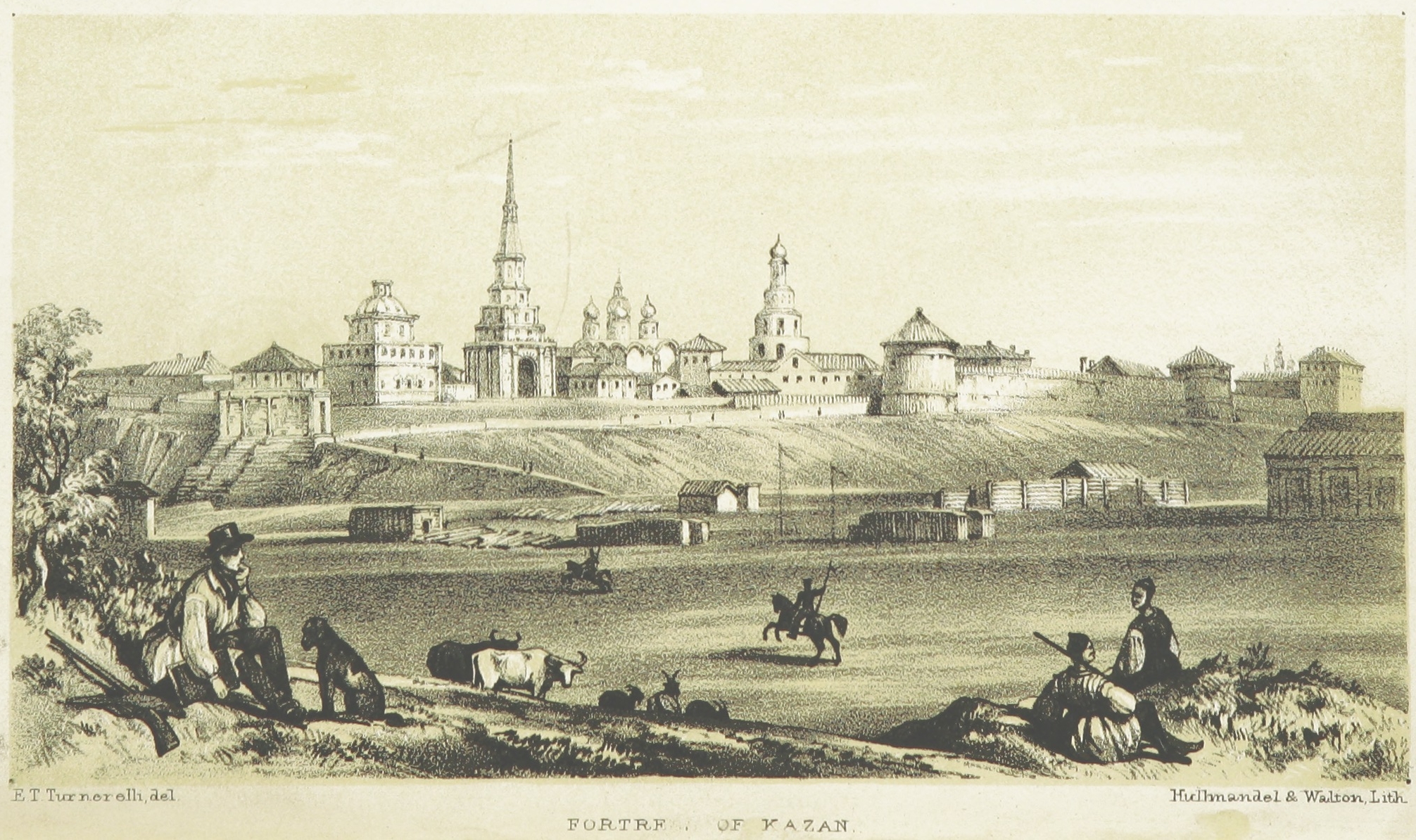
By the summer of 1774 the main drama shifted toward Kazan. Pugachev’s followers entered much of the city in July, while the Kremlin remained beyond their control, and the fighting brought terrible destruction. It was the kind of moment in which a revolt might appear to be on the verge of becoming a revolution. Streets burned, inhabitants fled, and officials confronted the possibility that a rebel claimant could hold one of the empire’s great regional centers. Yet the victory was incomplete almost as soon as it occurred. Government troops counterattacked, and the main rebel force suffered a serious defeat. Later paintings and lithographs fixed the attack in a single dramatic image, but the essential fact was the failure to convert a spectacular assault into defensible political control.
This failure mattered more than the burning skyline. An insurgent army could proclaim the end of a landlord’s authority as it passed through a district; it still needed to decide who would collect grain, adjudicate disputes, maintain roads and distribute ammunition after it had moved on. The surviving papers show that Pugachev’s leaders understood some of these problems. They also show that improvised administration was not enough to make the different constituencies of the uprising accept one durable government. The Romanov state possessed precisely the larger institutional system, however imperfect, that the rebellion was trying to displace. When peace with the Ottoman Empire in 1774 allowed Catherine to direct more attention and resources to the internal war, that advantage became increasingly decisive.
Pugachev’s fortunes collapsed as imperial units pressed the insurgents and their alliances frayed. After defeat on the lower Volga, members of his own circle handed him over to the authorities. The man who had borrowed the identity of an emperor now traveled under guard toward the real empress’s justice. His capture did not mean that every district immediately became peaceful. Resistance and punishment continued, and the fate of commanders and ordinary followers varied widely. But the arrest destroyed the central fiction around which the movement had rallied. There could be no surviving Peter III issuing new orders once the claimant was displayed as a prisoner of the government he had tried to overthrow.

That might have been the whole history: a dangerous uprising suppressed, its leaders executed and its supporters forced back under imperial authority. Instead, Catherine tried to alter the memory of the place from which the rebellion had emerged. In January 1775 the name Yaik was ordered replaced by Ural in the river and the associated Cossack designations; Yaitsk became Uralsk. The change did not amount to a wholesale destruction of records, but it was a clear political intervention in the landscape. An old name tied to a rebellious community was to disappear from official use. Recent historical scholarship on Orenburg’s place-names notes both the deliberate connection between the renaming and Pugachev and the loss of a Turkic name with a history older than Catherine’s reign. The government could not undo what happened at Orenburg and Kazan. It could try to decide what future generations would call those places and their inhabitants.
This is the point at which the historical rebellion and the theory of a vanished Tartary begin to overlap. The Romanovs did not merely defeat enemies; they renamed places, absorbed frontier institutions and presented their victories through official accounts. Those are the ordinary operations of empire, but they also give an alternative historian genuine material to work with. A state that changes the names of rivers after a revolt is demonstrably concerned with historical memory. If a dynasty can suppress one political identity, the larger question almost asks itself: how much older history might it have reshaped? Fomenko and Nosovsky answer by proposing that the Romanovs displaced a former Russian-Horde order and that struggles conventionally treated as internal rebellions were actually stages in the conquest of that order.
The resemblance they draw between Pugachev and Stepan Razin, the Cossack rebel of the previous century, is part of this reconstruction. Razin’s rising took place in the 1660s and early 1670s, and it too threatened imperial authority along major waterways. His image circulated widely in European engravings, a reminder that foreign observers had long regarded Russia’s frontier upheavals as events of international interest. The New Chronology incorporates such revolts into a larger account of the Romanovs’ struggle against the remains of an older empire. There is a recognizable pattern of frontier resistance here, but a pattern is not itself a single continuous government. Two rebellions separated by a century can have parallel causes without being the campaigns of the same suppressed state.

The name Tartary gives the theory its continental scale. European cartographers used versions of the word for centuries, sometimes spreading it across an almost unbelievable expanse of northern and central Asia. One map might identify Muscovite Tartary, another Chinese Tartary, and a third a supposedly independent Tartary between different imperial spheres. These are real labels on real printed maps. They invite the suspicion that a political world once existed under names that later vanished from school atlases. If the reader approaches those maps after learning about Catherine’s renaming of the Yaik, the suspicion becomes stronger: perhaps the territories were not simply renamed in the course of exploration and conquest, but had belonged to a state whose very memory the victors wanted removed.
The difficulty is that the maps do not all describe the same thing. Guillaume Delisle’s Carte de Tartarie, issued in the early eighteenth century, attempts to organize information drawn from travelers and earlier geographers. Its divisions reflect the knowledge and assumptions of the people who made and read it, including varying degrees of certainty about who held power in remote districts. The Library of Congress has traced the label across maps from the sixteenth through nineteenth centuries and shown how it covered diverse peoples and shifting areas rather than one stable government. On one early map a vast space appears under a single word even though no single great khan exercised authority over all of it. Later maps are more specific, not necessarily because every political structure beneath the old label was destroyed at one particular moment, but because geographers acquired different information and new empires imposed their own administrative terms.

None of this makes the maps meaningless. They preserve the perceptions of the people who produced them, and their changing names can reveal shifts in trade, diplomacy, conquest and the circulation of geographic knowledge. Nor does it make Russian expansion harmless. Over centuries, Siberian communities, steppe peoples and Cossack societies experienced profound disruptions as Muscovite and then imperial power advanced into their territories. The mistake is to assume that the word Tartary could only have referred to one state and that its disappearance must therefore mark one secret war. A cartographic label can contain many political realities, just as the term India on an old European map could cover jurisdictions whose rulers did not answer to the same sovereign.
Tobolsk becomes especially important within the New Chronology because Fomenko and Nosovsky identify it as the capital of what they call Muscovite Tartary, a rival state supposedly defeated in the war of 1773–75. It was certainly an important Siberian administrative and commercial center, and its name appears prominently on maps and geographical descriptions. Photographs taken much later show a substantial city whose architectural legacy is plainly real. But historical prominence is not the same as proof of a separate sovereign capital. For the stronger claim, it would be necessary to demonstrate how the alleged government in Tobolsk commanded military formations, collected revenue, appointed officials and conducted relations independently of the institutions of the Russian Empire. An old geographical entry or a large printed place-name cannot by itself establish those connections.

It is tempting, at this point, to dismiss the entire affair as a curiosity of antiquarian map collecting. That would miss what makes the theory persuasive to some readers. The Romanovs really did expand their power at the expense of other communities. They really did employ coercion and historical symbolism. Pugachev’s rebels really did establish a provisional authority that issued documents in the name of an emperor whom the official court insisted was dead. If the evidence consisted only of a portrait, a map and an imperial proclamation, a dramatic reconstruction could arrange them into almost any sequence. The surviving record, however, is much more stubborn than that. It contains mundane details that do not easily resolve into a single secret history.
The documentary collection of Pugachev’s headquarters includes decrees addressed to particular officers, instructions to communities, passes, receipts and lists of supplies. The papers were often written by clerks rather than by the claimant personally, and some archives are incomplete. Yet the surviving administrative fragments allow a historian to follow actual transactions and relationships: which officer received instructions, what resources were being demanded, where the insurgent command thought it had influence, and how subordinates reported back. In other words, the evidence permits a much more exact account of rebel power than the phrase lost empire can offer. It also prevents the revolt from becoming a simple morality play. Some proclamations offered liberation; armed men carrying them could practice extortion, punish resistance and frighten the very people whose support they needed.

The record is also unmistakably multinational. Bashkir participation cannot be reduced to the restoration of one Cossack political tradition, any more than the grievances of Russian serfs can be made identical to the calculations of frontier officers. Each group encountered the expanding imperial state through different legal arrangements and memories of obligation. Some leaders supported Pugachev, some negotiated with government commanders, and others changed sides as the outcome became clear. Those differences are not inconvenient scraps that historians have added to obscure the truth. They are the substance of the conflict. An interpretation that flattens them into the last army of a unified continental sovereign risks erasing the people it claims to recover.
The longer history of Russia makes this problem still more complicated. The Romanovs came to power in 1613 after the Time of Troubles, and the dynasty’s story is full of contested succession, military expansion and deliberate claims about continuity with an older past. That record is not above criticism. Rulers patronized chronicles, censored publications, arranged dynastic narratives and commissioned the images by which they hoped to be remembered. But a comprehensive replacement of accepted Eurasian chronology would need to account for independent evidence in neighboring states, commercial records, inscriptions, dated objects and writings that were not produced by a single Romanov archive. The historian Charles Halperin has criticized Fomenko and Nosovsky’s method precisely for building enormous chronological revisions on comparisons and identifications that fail when placed against such independent material. The burden of demonstrating a rival empire cannot be shifted onto every person who asks where its documents are.
The nineteenth century offers a revealing counterpoint. Alexander Pushkin investigated the rebellion, visited places connected with it and published his History of the Pugachev Rebellion in 1834. He worked under the monarchy, and the accounts available to him carried all the pressures and omissions of imperial memory, but his book itself is a record of the revolt’s persistence. Pugachev did not disappear into the silence Catherine wanted. The documents remained scattered through archives, official reports, family recollections and regional traditions; historians have continued to recover them. The same state that renamed the Yaik failed to erase the war. That failure is important because a theory of total suppression tends to turn every missing source into evidence that suppression succeeded, while treating surviving contrary material as something the authorities fabricated. Such an argument can become impossible to test.
The most consequential act of destruction visible in this story was not the mysterious disappearance of a world-spanning civilization. It was the very tangible subordination of people who challenged an expanding empire, followed by the attempt to impose a victorious vocabulary upon the territory where they had fought. That was enough to change lives, jurisdictions and the words printed on maps. It is also more historically difficult than a single war between two perfectly defined states, because there was no single frontier interest for the Romanovs to conquer, and no one rebel authority that spoke for everybody living across the Volga, the Urals and Siberia. The differences matter. They tell us what the empire was actually expanding into.
At the end of the story, Pugachev’s fate and the name Tartary still sit uneasily beside one another. The scaffold in Moscow proves that Catherine could destroy a challenger to her throne. The altered name of the Yaik proves that she could try to shape the memory of his defeat. The early maps prove that Europeans once described great areas of Asia with regional terms that have since fallen out of use. All three are genuine historical facts. What remains unproved is the further claim that they are fragments of one concealed conquest, the destruction of a sovereign empire headquartered in Tobolsk. The better history is not less dramatic for refusing that leap. It follows the soldiers and clerks, the town walls and river routes, the competing allegiances and surviving papers, and finds in them a struggle over who had the right to govern and whose account of that struggle would endure. Catherine won the war. She did not succeed in making it disappear.